Tetraneutron observed: a 'nucleus' made of just four neutrons
Published in Nature on 22 June 2022, the work was led by Meytal Duer of TU Darmstadt.
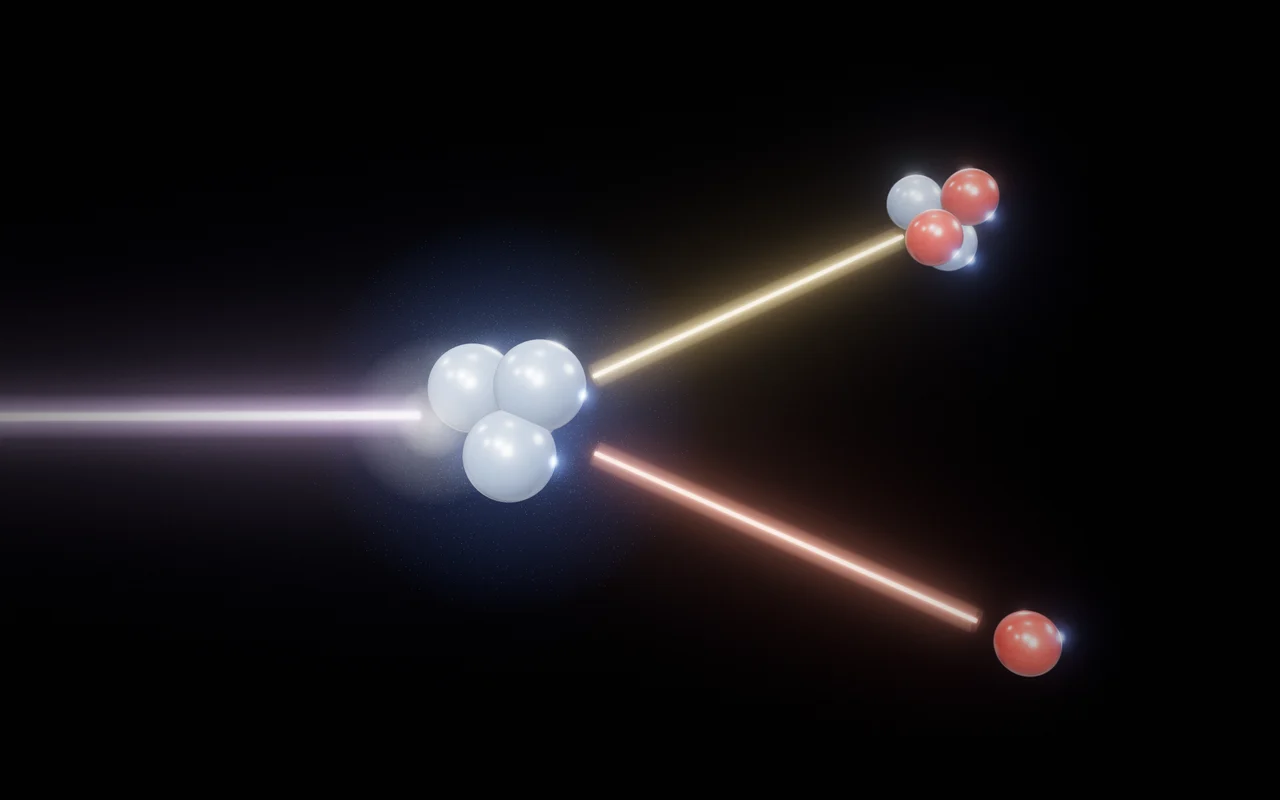
Image: Virtual Lab (3D illustration)
Atomic nuclei are made of protons and neutrons. Two or three neutrons cannot stick together — they fly apart at once. How nuclear forces act among neutrons, especially more than two, is still not fully known, so a system of neutrons alone is the cleanest 'laboratory' for testing theory.
The team used helium-8: 2 protons and 6 neutrons, essentially a helium-4 nucleus plus four extra neutrons. A helium-8 beam travelling at about half the speed of light hit a liquid-hydrogen target. In some collisions a proton knocked out the helium-4 core, leaving four neutrons on their own.
Neutrons are hard to see directly, so the researchers precisely measured the speeds of the knocked-out proton and helium-4 and used them to calculate the four neutrons' energy. A sharp 'peak' appeared at a particular energy — a sign that the four neutrons were briefly bound — with a significance above 5 standard deviations.
The tetraneutron lives about 10⁻²² seconds before splitting into four free neutrons — fleeting, but significant on nuclear timescales. Many theoretical calculations had said such a state should not exist, so the result pushes physicists to rethink their picture of nuclear forces.
 Try it in the labRadioactivity3D lab on this site →Share on Telegram
Sources: Nature (DOI) · Chalmers