LHCb finds three new exotic particles: a strange pentaquark and a tetraquark pair
The discoveries were announced at a CERN seminar on 5 July 2022 — the same day the Large Hadron Collider began running at a new record energy.
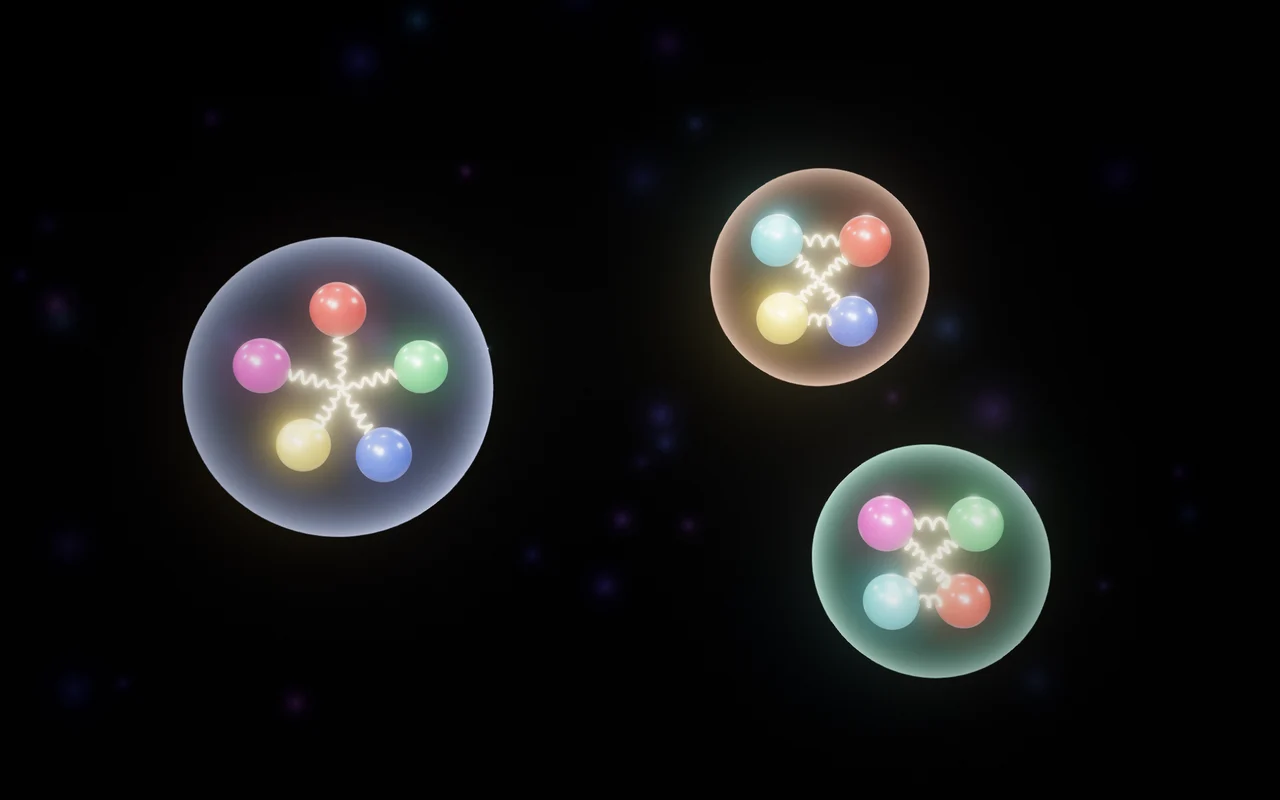
Image: Virtual Lab (3D illustration)
Ordinary particles like protons and neutrons contain three quarks, and mesons a quark and an antiquark. But quantum chromodynamics also allows particles with more: four-quark tetraquarks and five-quark pentaquarks, known as 'exotic hadrons'. The first were found in the 2000s.
The new pentaquark contains a charm quark, a charm antiquark and an up, a down and a strange quark. It was found by analysing decays of negatively charged B mesons, with a significance above 15 standard deviations — three times the 5 needed to claim a discovery.
The doubly charged tetraquark consists of a charm quark, a strange antiquark, an up quark and a down antiquark, and was found together with its neutral partner — the first pair of tetraquarks ever seen — with significances of 6.5 and 8 standard deviations.
Such particles reveal how quarks bind: they may be tightly bound wholes or 'molecules' of two ordinary particles. 'We're creating particle zoo 2.0,' said LHCb physics coordinator Niels Tuning. The experiment soon introduced a new naming scheme for these particles.
 Try it in the labCloud chamber3D lab on this site →Share on Telegram