The W boson weighs in heavier than expected: CDF's surprising measurement
The result was published in Science on 7 April 2022, analysing data collected at the Tevatron collider between 2002 and 2011.
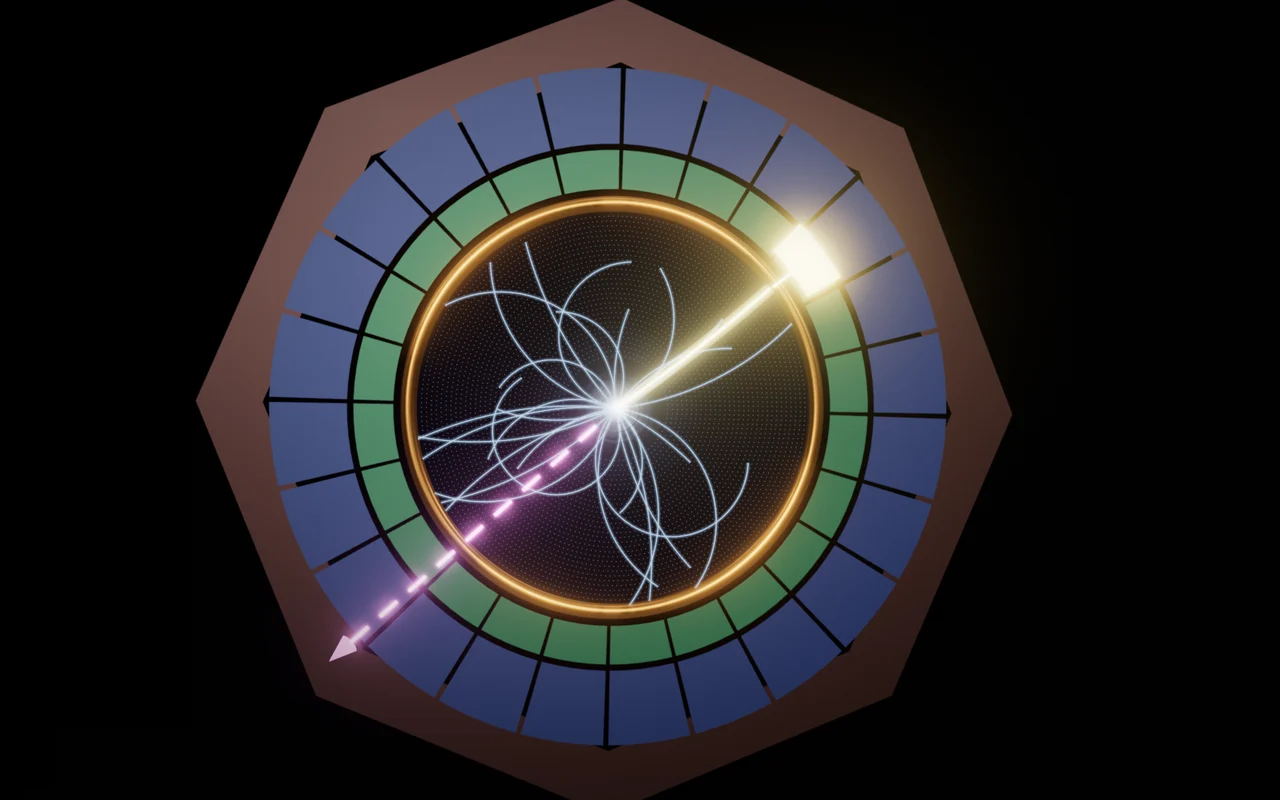
Image: Virtual Lab (3D illustration)
The W boson carries the weak nuclear force — the force that lets nuclear reactions run inside the Sun and makes some nuclei decay. Discovered at CERN in 1983, it is 85 times heavier than a proton, roughly as heavy as a whole bromine atom.
The Tevatron collided protons with antiprotons. A W boson instantly decays into an electron or muon plus a neutrino, so it cannot be weighed directly: its mass is worked out by measuring how electrons and muons bend in a magnetic field.
Some 400 scientists spent a decade analysing about 4 million W boson events. The result was 80,433.5 ± 9.4 MeV — a precision of one part in ten thousand. The Standard Model predicts 80,357 ± 6 MeV. The difference looks small but is huge compared with the uncertainties: 7 standard deviations.
If correct, it would point to unknown particles or forces. Other experiments set out to check it, and in 2023–2024 ATLAS and CMS at CERN remeasured the W mass and found values consistent with the Standard Model. The CDF result remains an unexplained puzzle.
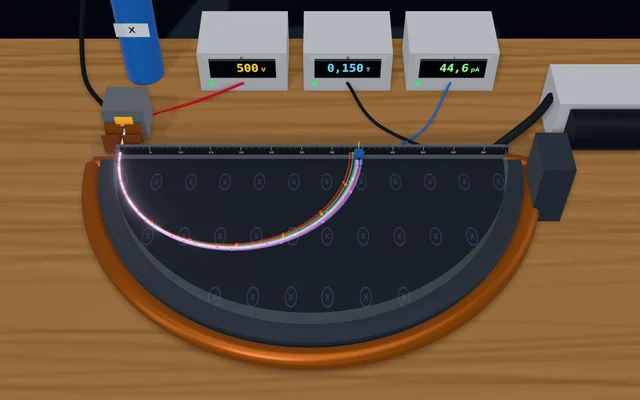 Try it in the labMass spectrometer3D lab on this site →Share on Telegram
Sources: Fermilab / ScienceDaily · CERN Courier