Home › Nobel Prize laureates › 1996–2005 › 1997

Steven Chu
born 1948 · USA
Prize motivation“for development of methods to cool and trap atoms with laser light”
Shared the prize with: Claude Cohen-Tannoudji, William D. Phillips
The discovery
At room temperature, air molecules fly at hundreds of metres per second. To study atoms precisely, they must be almost stopped, that is, cooled to very low temperatures.
When an atom absorbs a photon it gets a small kick in the photon's direction. With the laser frequency tuned just right, an atom absorbs photons only when moving towards the beam, so it slows down. In 1985 at Bell Labs, Steven Chu lit atoms from six directions with lasers and slowed them as if they were stuck in thick syrup, which was called “optical molasses”.
William Phillips measured that the atoms were even colder than theory predicted. Claude Cohen-Tannoudji and his group explained why and found ways to reach still lower temperatures, cooling atoms to millionths of a degree above absolute zero.
Life
Born on 28 February 1948 in St Louis, USA, he graduated from the University of Rochester and earned his doctorate at the University of California, Berkeley, in 1976.
He worked at Bell Labs from 1978 to 1987 and then at Stanford, was director of Lawrence Berkeley National Laboratory from 2004 to 2009, and returned to Stanford as a professor in 2013.
Where it is used today
Laser-cooled atoms are the basis of the world's most accurate atomic clocks, used in satellite navigation (GPS) and international timekeeping.
These methods also proved essential for making Bose–Einstein condensates, atom interferometers and quantum computers.
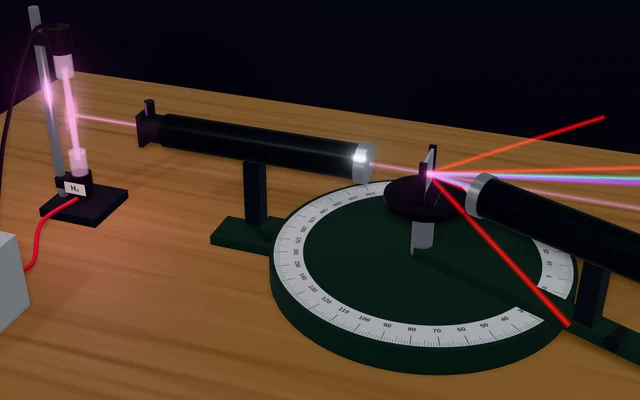 Try it in the labAtomic spectra3D lab on this site →Share on Telegram
Sources: NobelPrize.org — 1997