Physicists sent a message through a brick wall using gravity
The experiment was carried out at the University of Queensland, Australia, and published in Science Advances on 19 November 2026.
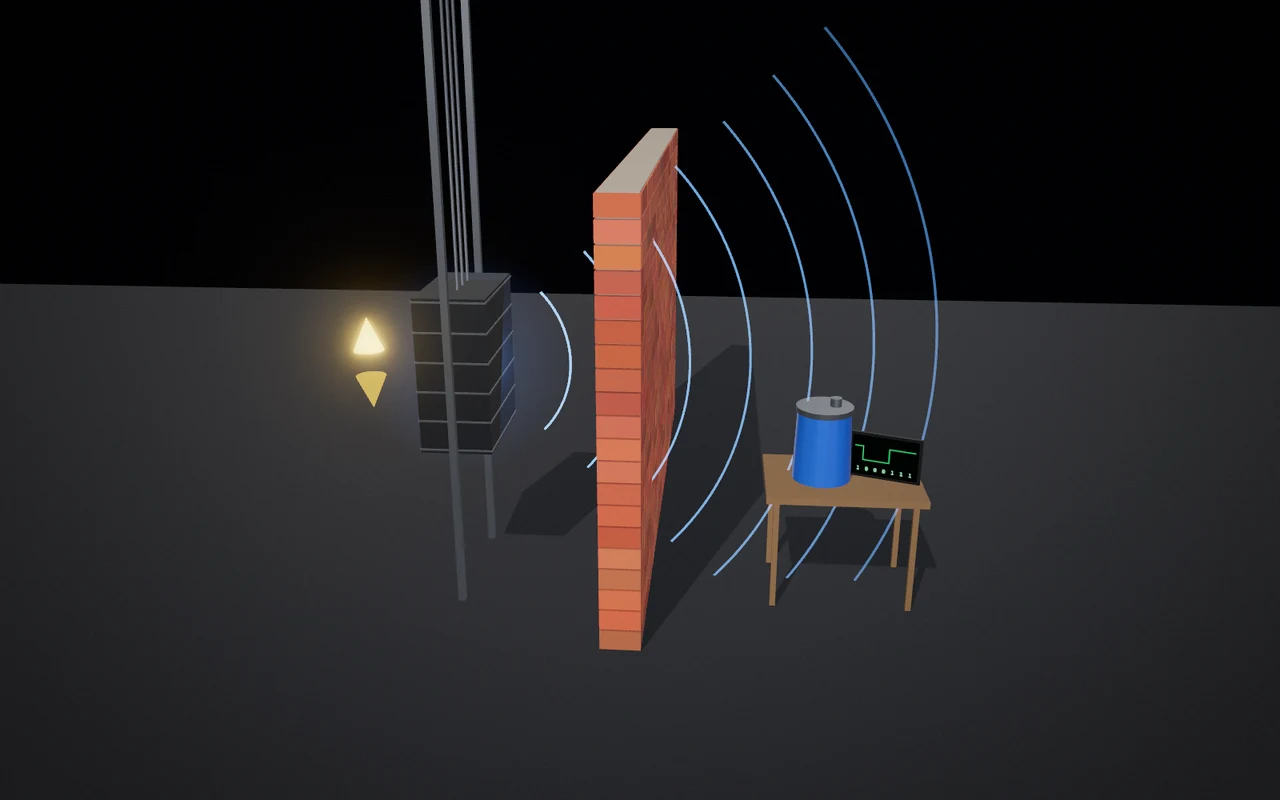
Image: Virtual Lab (3D illustration)
Phones, Wi-Fi and radio all use electromagnetic waves. But thick walls, soil or a metal shell can block them — which is why you lose signal in a tunnel. The researchers asked: is there a communication channel that nothing can block? Their answer was gravity.
Every mass pulls on the objects around it, and there is no way to shield against that pull. Move a heavy object and the gravity nearby changes, even if only very slightly. A very sensitive instrument, a gravimeter, can detect the change. So by encoding the position of a heavy object as '1' and '0', you can send a message.
The team used a 1950s lift in their university building. The lift's heavy counterweight was moved up or down its shaft, while in the room on the other side of a brick wall a gravimeter measured the change in gravity. The shortest distance between the instrument and the weight was just 0.68 metres. The seven-letter word 'Gravity' was sent as a 49-bit code, and the received code matched the transmitted one exactly.
Because the lift is so slow, the rate was just 1 bit per minute — about an hour for a single word. This is not gravitational waves but ordinary Newtonian gravity. The researchers think that with more sensitive instruments and faster-moving masses such links could become much faster.
 Try it in the labFree fall3D lab on this site →Share on Telegram
Sources: EurekAlert (UQ) · arXiv · Gizmodo