Radio waves steer the magnet inside a single atom's nucleus
On 27 October the results were published in Nature Communications.

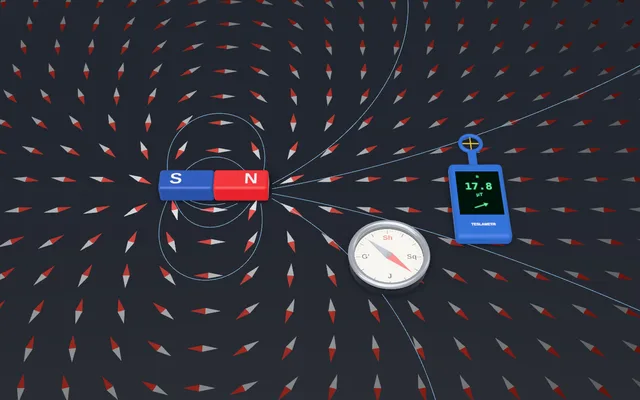
Image: Virtual Lab (3D illustration)
Every atom contains several tiny “compass needles” called spins. By far the strongest magnetism comes from the electrons, but in some atoms the nucleus is a small magnet too, with its own nuclear spin. It is much weaker than the electron spin but far better shielded from disturbances, which makes it prized for storing quantum information.
The team adapted a scanning tunnelling microscope to send highly precise electrical signals through its sharp tip to a single atom. They applied two different signals at once, one aimed at the electron spin and one at the nuclear spin. Lead author Hester Vennema compares spins to guitar strings, each with its own note; the nuclear notes are 100 to 1,000 times lower than the electron's.
The surprise was that the nuclear spin could be flipped even when it was almost decoupled from the electron spin. The nuclear spin was thought to be completely insensitive to the microscope's electrical signals. “By our simple understanding, this should not really happen,” said lead researcher Sander Otte.
The mechanism is not yet understood. “Back to the drawing board, then,” Otte said. But the result could open new ways to store and read out quantum information securely in nuclear spins.
 Try it in the labMagnetic field3D lab on this site →Share on Telegram
Sources: TU Delft · ScienceDaily