Electrons' “impossible” quantum jumps caught on video
Scientists from the universities of Regensburg and Marburg and Forschungszentrum Jülich published the results in Nature.

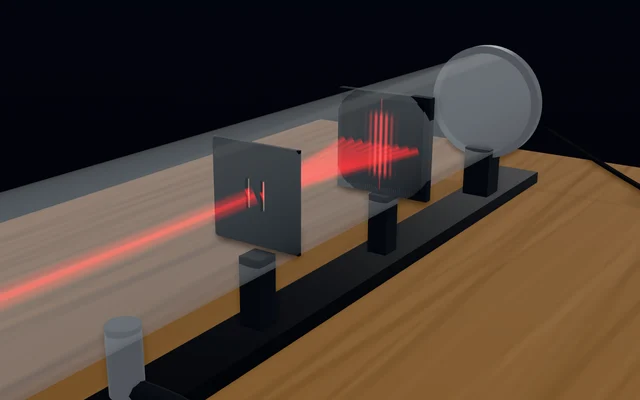
Image: Virtual Lab (3D illustration)
In solids, electrons can only have energies within certain ranges called bands. Between the bands lies a forbidden gap where, normally, an electron can neither stay nor cross. Picture a lift that stops only at the 3rd and 20th floors, with nothing in between.
In a very strong electric field, though, an electron can leap across the gap in an instant. This is called a Landau–Zener–Majorana transition, predicted independently by three theorists in the 1930s. It happens so fast that nobody had ever watched it directly.
The team shone intense light pulses on ultra-pure, one-atom-thick graphene. The light's oscillating electric field accelerates the electrons and drives them through the energy landscape. A special “electron camera”, a photoemission momentum microscope, filmed this motion, resolving changes faster than a single oscillation of the light wave.
The result was a surprise: with a strong enough field, electrons crossed the forbidden gap with 100% probability. The leap depends on how fast an electron approaches the gap, which is different from ordinary quantum tunnelling. The team also saw electrons start out moving in an orderly way and then lose that order as they collide with the crystal lattice.
 Try it in the labQuantum interference3D lab on this site →Share on Telegram
Sources: ScienceDaily · Phys.org