First atmosphere found on a rocky planet in the habitable zone
The result was published in Science on 16 July 2026, in work led by Collin Cherubim of the Center for Astrophysics | Harvard & Smithsonian.
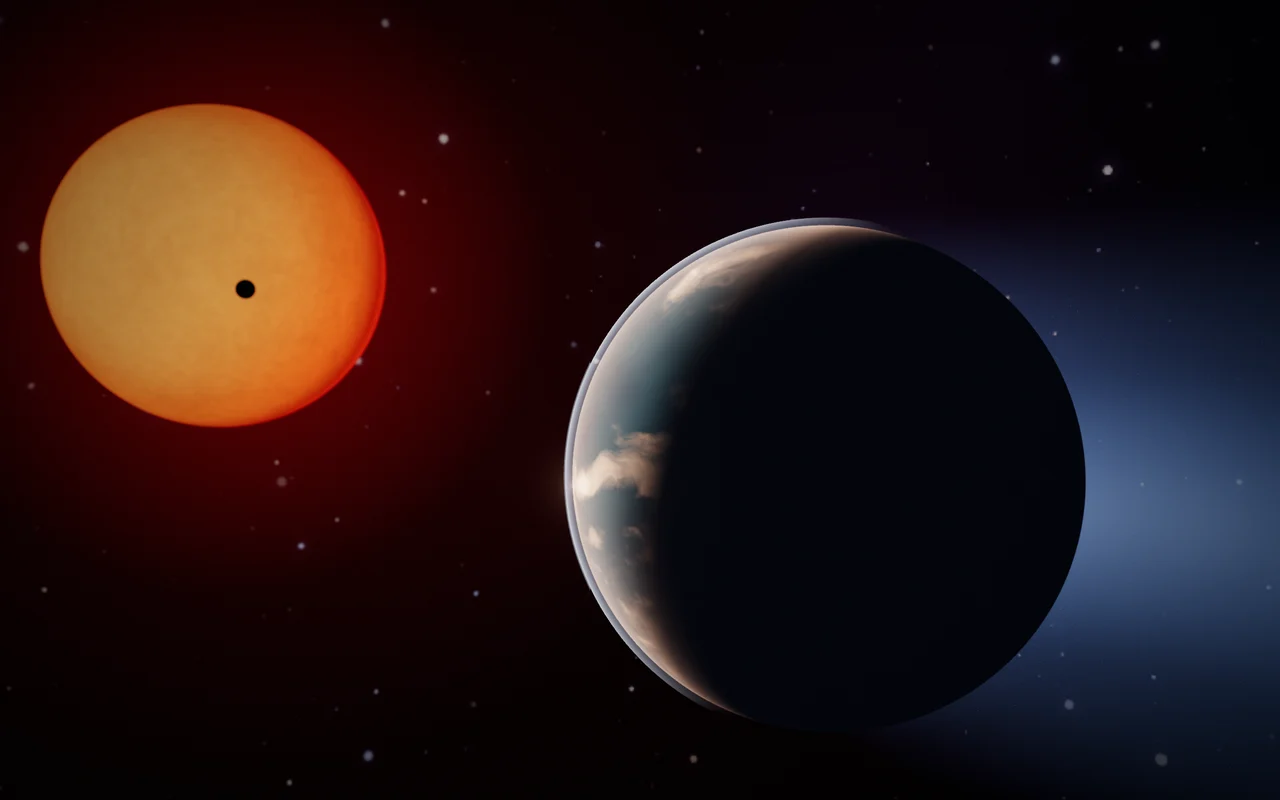
Image: Virtual Lab (3D illustration)
LHS 1140 b was discovered in 2017. It circles a small, cool red dwarf star about once every 25 days. The planet is 5.6 times as massive as Earth with 1.73 times its radius, and it lies in the 'habitable zone', where liquid water could exist on the surface. Models suggest it is a water world, with 9–19% of its mass in water.
When a planet passes in front of its star, some starlight filters through its atmosphere, and each gas absorbs light only at its own wavelengths. Using the WINERED infrared spectrograph on the Magellan Clay telescope in Chile, the team watched helium's line at 1083 nanometres, and during a transit in September 2024 they found extra absorption in it.
Helium is very light: it rises to the top of an atmosphere and slowly leaks into space, just as it does on Earth. If a planet is losing helium yet has not run out, there must be an atmosphere underneath replenishing it. X-rays from the star explain the measured loss rate well, and the atmosphere is estimated to have survived for some 3 billion years.
There is a cross-check, too: the neighbouring planet LHS 1140 c transited on the same night and showed no helium. Webb had earlier ruled out a thick hydrogen envelope on LHS 1140 b, so its atmosphere may be evolved, like Earth's. David Charbonneau, head of Harvard's astronomy department, called the detection 'statistically rock solid'.
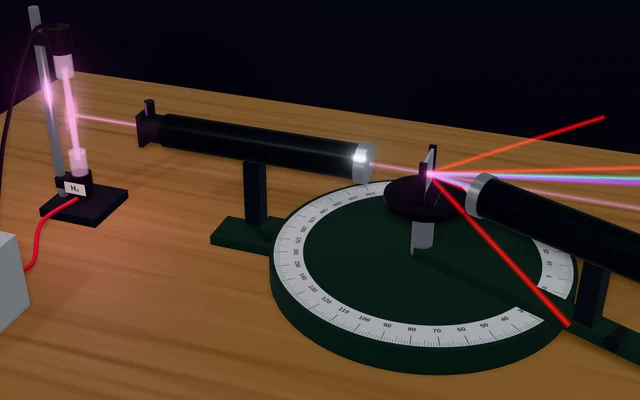 Try it in the labAtomic spectra3D lab on this site →Share on Telegram
Sources: EarthSky · Science (DOI)