Dark energy may be weakening
On 19 March the DESI collaboration announced results from three years of observations.
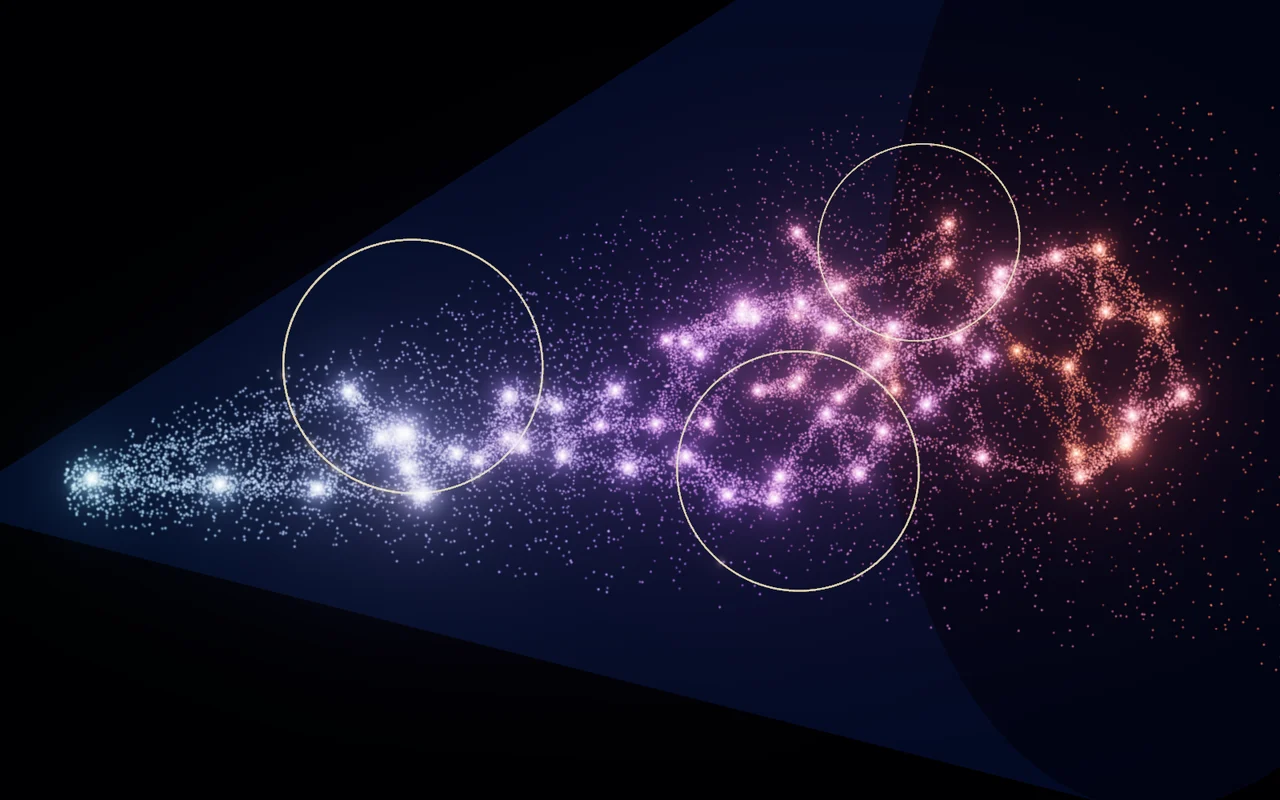
Image: Virtual Lab (3D illustration)
The Universe is expanding, and since 1998 we have known the expansion is speeding up. The cause is called dark energy: it makes up about 70% of the Universe, but its nature is unknown. The standard model treats it as unchanging, a cosmological constant.
DESI is an instrument on a 4-metre telescope in Arizona with 5,000 optical fibres, each pointed at a separate galaxy or quasar to record its spectrum. How far the spectral lines are shifted to the red, as in the Doppler effect, gives the object's distance, building a 3D map of millions of galaxies.
The map holds traces of baryon acoustic oscillations, “bubbles” of a fixed size left by sound waves in the early Universe. That size works as a cosmic ruler; measuring it at different epochs let scientists track how the Universe expanded over the last 11 billion years.
On its own, the DESI data still fits the standard model. But combined with measurements of the cosmic microwave background and supernovae, the signs that dark energy is weakening reach 2.8 to 4.2 sigma. A formal discovery needs 5 sigma, so for now it is a strong hint.
 Try it in the labThe Doppler effect3D lab on this site →Share on Telegram
Sources: Quanta Magazine · UT Dallas