The heaviest antimatter nucleus ever found
The STAR collaboration published the result in Nature on 21 August 2024.
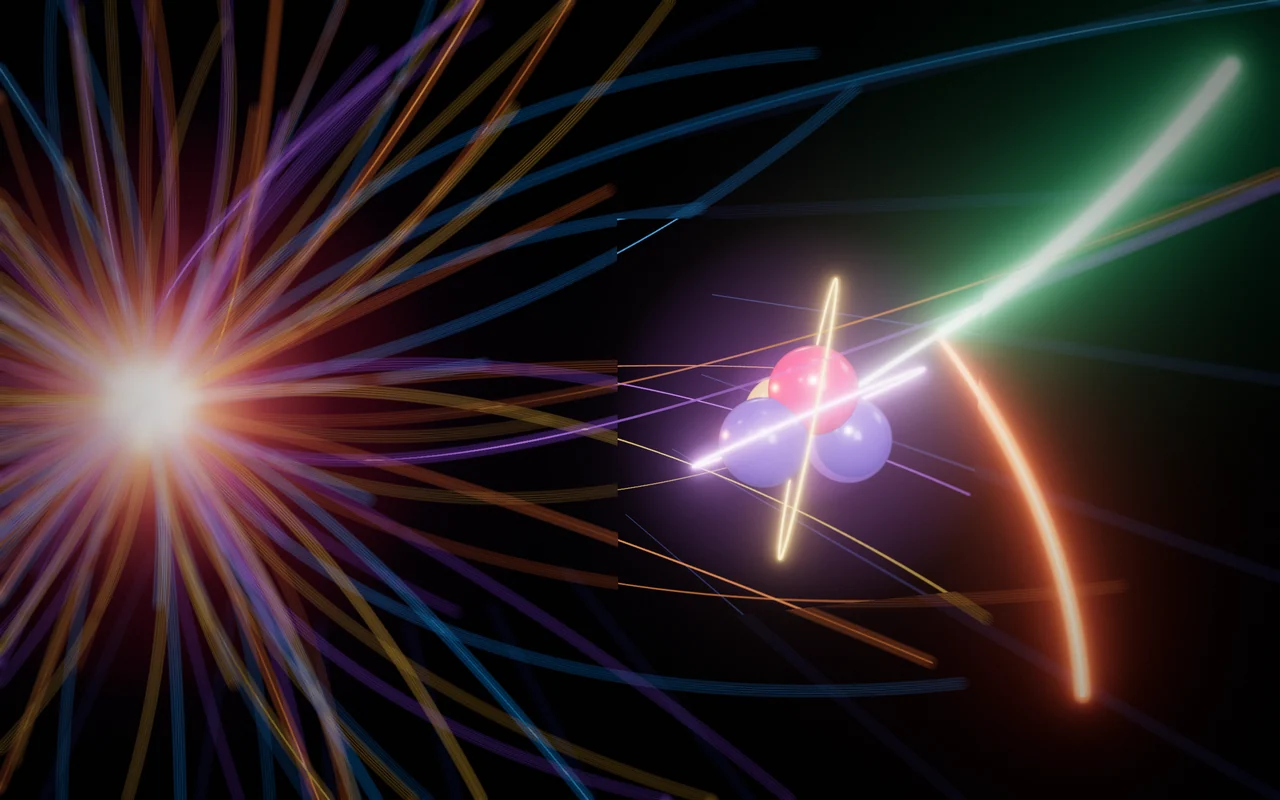
Image: Virtual Lab (3D illustration)
The universe is thought to have begun with equal amounts of matter and antimatter, which annihilate when they meet. Yet for some reason matter 'won', and we live in a world made of it. This is one of the biggest mysteries in physics.
To probe it, scientists make antimatter in the lab and compare its properties with those of matter. The RHIC collider at Brookhaven National Laboratory smashes heavy nuclei together at nearly the speed of light, creating fireballs of several trillion degrees — like the universe's first moments.
For antihyperhydrogen-4 to form, four antiparticles must emerge at the same place, at the same time and in the same direction, so it is extremely rare. It is also unstable, decaying into an antihelium-4 nucleus and a negative pion. The STAR detector searched for these decay tracks and found about 16 events among 6 billion collisions.
The scientists compared the new nucleus's lifetime with that of its 'ordinary' partner, hyperhydrogen-4. Within the precision of the measurement they were the same — another confirmation of the symmetry between matter and antimatter.
 Try it in the labMass spectrometer3D lab on this site →Share on Telegram
Sources: Brookhaven National Laboratory · ScienceDaily