Oxygen-28 observed for the first time — and the 'magic' nucleus surprised everyone
The result was published in Nature on 30 August 2023, in work led by Yosuke Kondo of the Tokyo Institute of Technology and RIKEN.
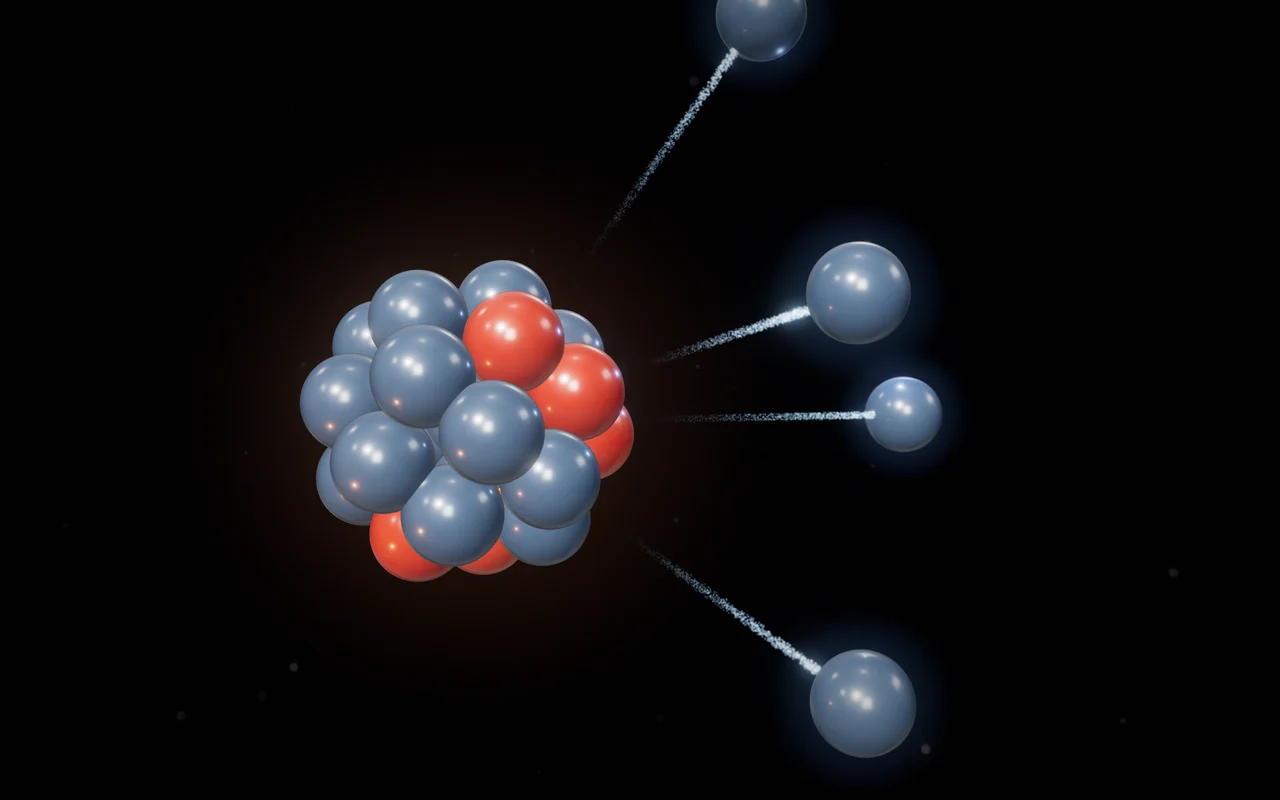
Image: Virtual Lab (3D illustration)
Protons and neutrons in a nucleus, like electrons in an atom, fill 'shells', and a full shell makes a nucleus especially sturdy. The numbers that fill them — 2, 8, 20, 28, 50, 82 and 126 — are called 'magic'. When both protons and neutrons are magic, the nucleus is 'doubly magic', like ordinary oxygen-16.
Oxygen-28 has 8 protons and 20 neutrons, so it too should be doubly magic, and for years some thought it might even be stable. But it carries 12 more neutrons than stable oxygen-16, making it extremely hard to create and observe.
At RIKEN's Radioactive Isotope Beam Factory, a beam of fluorine-29 nuclei was fired at a liquid-hydrogen target. Knocking a proton out of fluorine produced oxygen-28, which almost immediately broke into oxygen-24 and four neutrons. The detectors caught all four neutrons at once — a first.
Oxygen-28 lived about a zeptosecond — a trillionth of a billionth of a second. Its energy and production rate showed it lacks a closed 'magic' 20-neutron shell, suggesting magic numbers can lose their power in extremely neutron-rich nuclei.
 Try it in the labRadioactivity3D lab on this site →Share on Telegram
Sources: Science News · Nature (DOI)