Webb finds methane and carbon dioxide on habitable-zone planet K2-18 b
The result was announced on 11 September 2023 and published in The Astrophysical Journal Letters, in work led by Nikku Madhusudhan of the University of Cambridge.
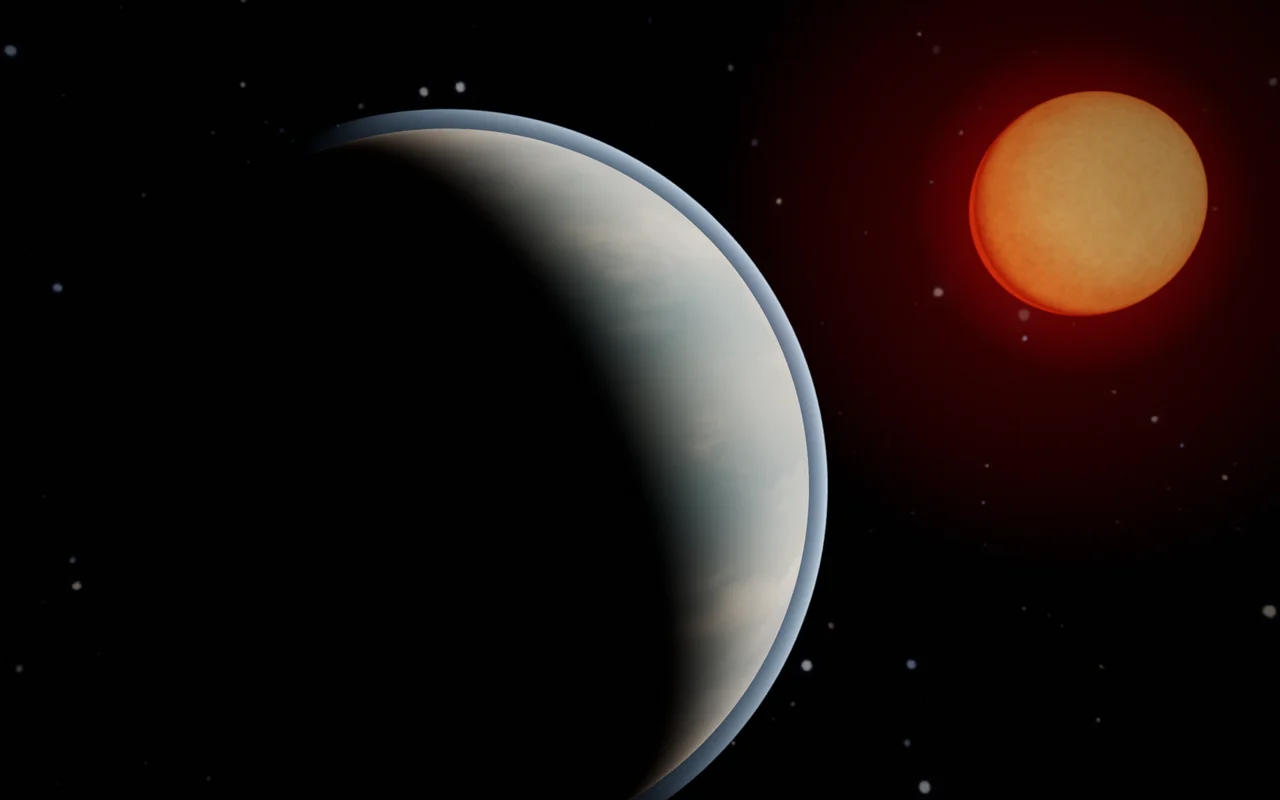
Image: Virtual Lab (3D illustration)
K2-18 b orbits a cool red dwarf in the constellation Leo, within its star's habitable zone. It has 8.6 times Earth's mass and 2.6 times its radius. Planets between Earth and Neptune in size are called sub-Neptunes; the solar system has none, yet they are the most common type of planet in the galaxy.
Webb's NIRISS and NIRSpec instruments analysed starlight that passed through the planet's atmosphere as it crossed its star. Each molecule absorbs light at its own wavelengths, and the spectrum showed clear signs of methane and carbon dioxide, with a shortage of ammonia.
Plenty of methane and carbon dioxide but little ammonia fits the idea of a water ocean beneath a hydrogen-rich atmosphere. The interior is expected to hold a layer of high-pressure ice, like Neptune, and the ocean could also be too hot for life, or not liquid at all.
The data also hinted at dimethyl sulphide (DMS), which on Earth is made only by living things, mainly marine phytoplankton. But that signal is much weaker and needs confirming with further observations; many scientists say it is too early to draw conclusions.
 Try it in the labAtomic spectra3D lab on this site →Share on Telegram