The heaviest 'Schrödinger's cat': a 16-microgram crystal in two states at once
The result was published in Science on 20 April 2023, in work led by Professor Yiwen Chu of ETH Zurich.
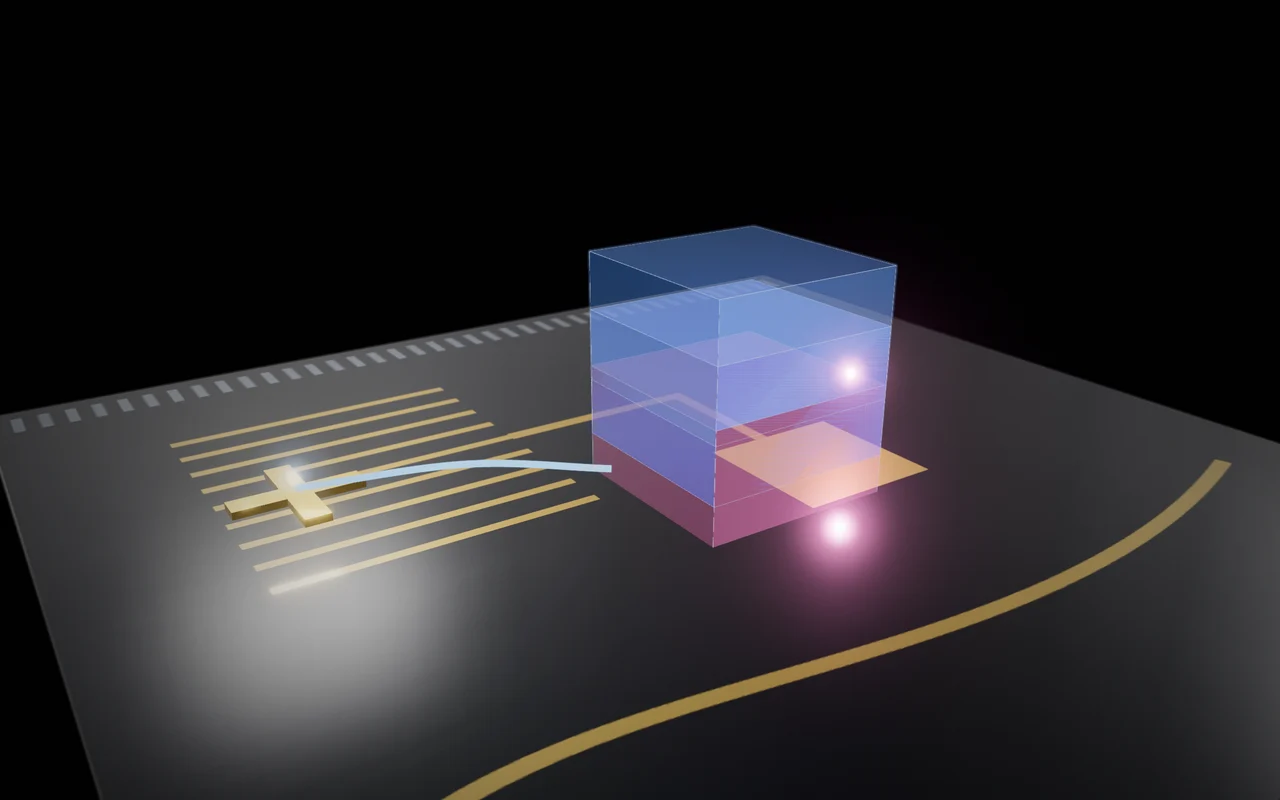
Image: Virtual Lab (3D illustration)
In 1935 Erwin Schrödinger proposed his famous thought experiment: a cat in a box whose fate hangs on the decay of a single atom. According to quantum mechanics, until the box is opened the cat is both alive and dead. The idea was meant to show how strange quantum rules look when applied to large objects.
That cannot be done with a real cat. The ETH team used a sapphire crystal as the 'cat' and a superconducting qubit as the 'atom', linked by a piezoelectric layer that produces an electric field when the crystal changes shape and so lets it 'talk' to the qubit.
The qubit was put into a superposition of two states, which was then transferred to the crystal's vibration. The crystal began oscillating in two opposite phases at once — up-down and down-up. An object of about 100 quadrillion atoms was in a quantum state.
The two states differ by a tiny amount, about a billionth of a nanometre — yet that is larger than the quantum uncertainty, so they can be told apart reliably. 'Of course, in the lab we can't realise such an experiment with an actual cat weighing several kilograms,' says Yiwen Chu.
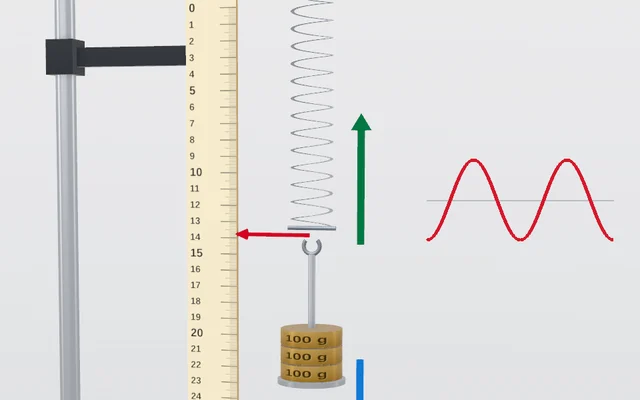 Try it in the labSpring pendulum3D lab on this site →Share on Telegram
Sources: ETH Zurich · Live Science