A black hole and its jet captured together for the first time
The result was published in Nature on 26 April 2023, in work led by Ru-Sen Lu of the Shanghai Astronomical Observatory.
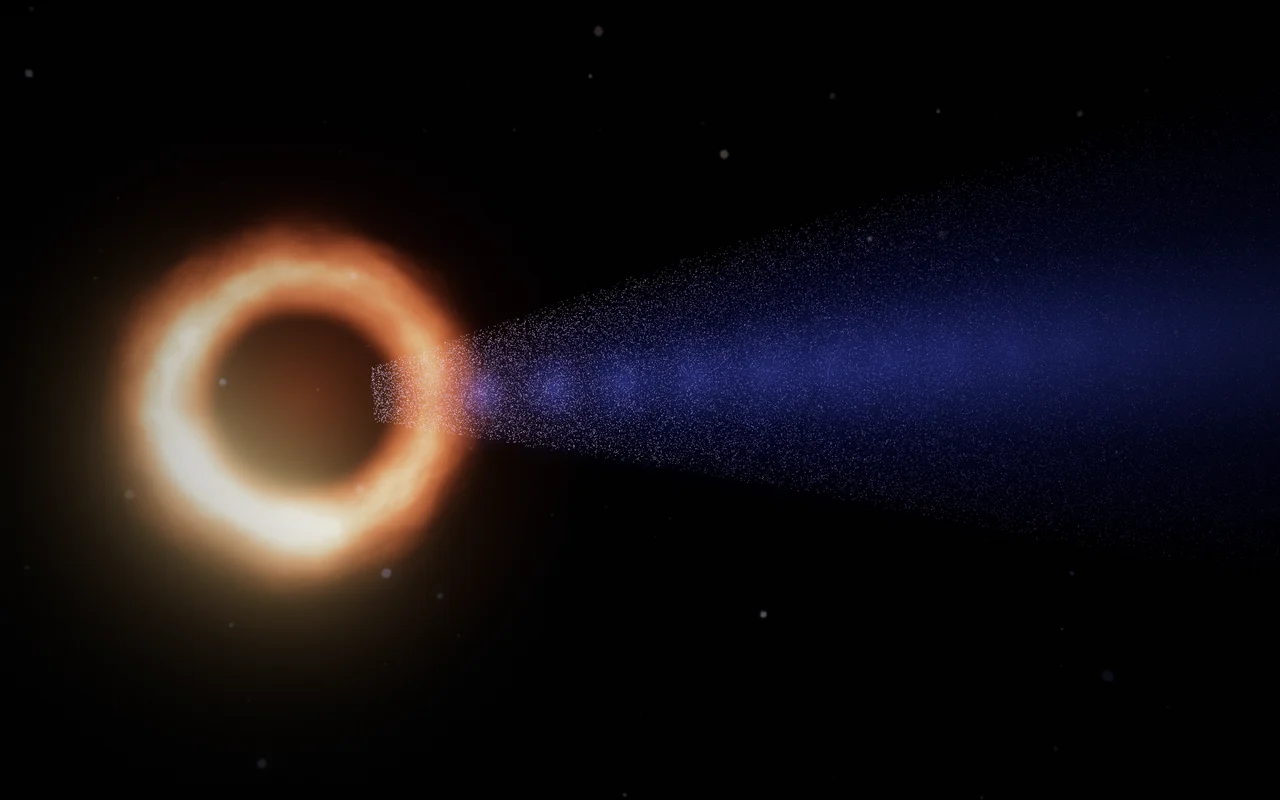
Image: Virtual Lab (3D illustration)
In 2019 the Event Horizon Telescope (EHT) released the first-ever image of a black hole — the 6.5-billion-solar-mass giant at the centre of galaxy M87. It showed a bright ring around a dark 'shadow', but not the famous jet that stretches thousands of light years from the galaxy.
The new observations were made at a wavelength of 3.5 mm, with ALMA in Chile and the Greenland Telescope joining the Global Millimetre VLBI Array. Combining signals from distant telescopes creates one huge 'virtual telescope' the size of Earth — an interference technique able to resolve extremely fine detail.
The image shows the base of the jet connecting directly to the ring around the black hole. The ring measures 64 microarcseconds across — the apparent size of a 13-centimetre ring on the Moon seen from Earth — about 50% larger than the ring seen by the EHT.
The team thinks the difference comes from extra emission by material falling into the black hole; besides infalling gas there may also be a wind blowing outwards. 'This gives us a more complete view of the physical processes acting near the black hole,' says Ru-Sen Lu.
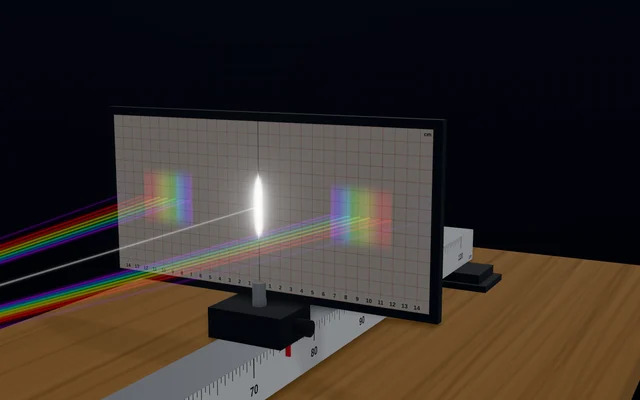 Try it in the labInterference3D lab on this site →Share on Telegram
Sources: SHAO · MIT Haystack