Webb confirms its first exoplanet: Earth-sized LHS 475 b
The result was announced on 11 January 2023 at the American Astronomical Society meeting, by a team led by Kevin Stevenson and Jacob Lustig-Yaeger of the Johns Hopkins University Applied Physics Laboratory.
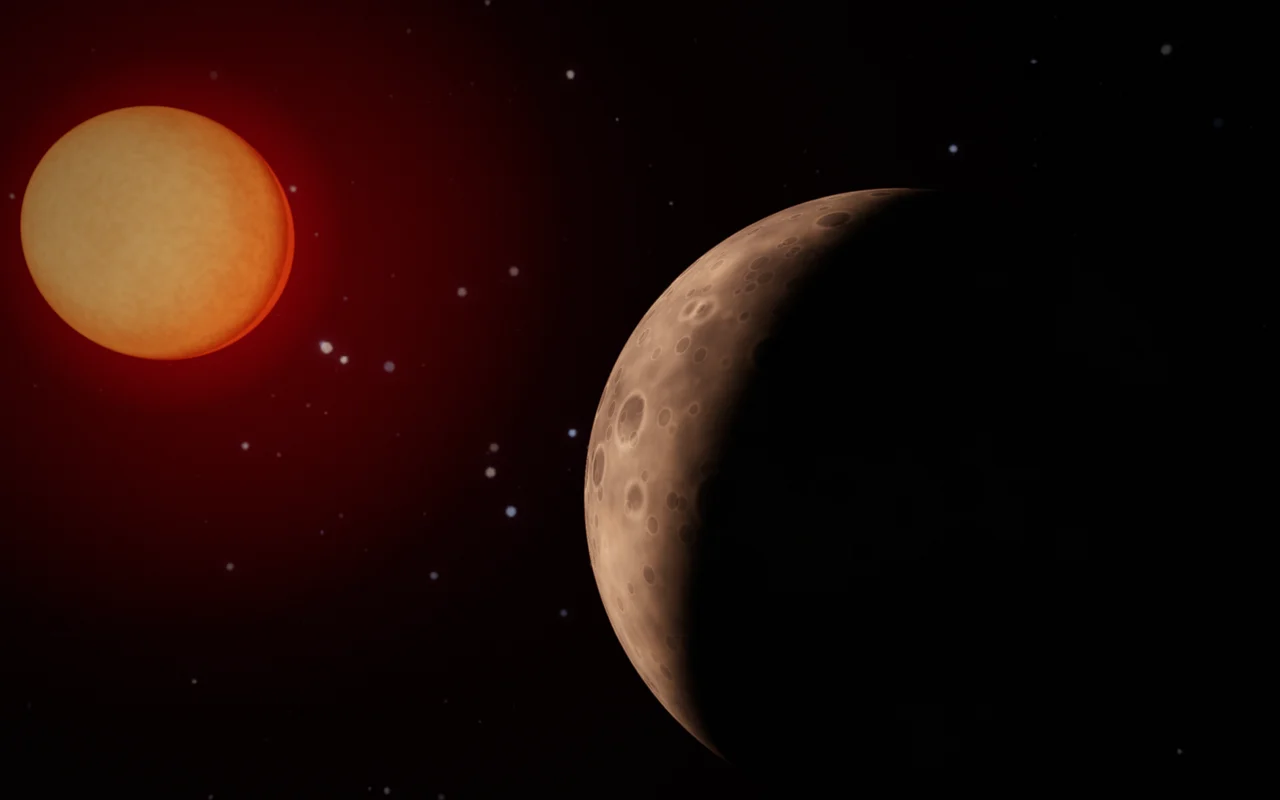
Image: Virtual Lab (3D illustration)
LHS 475 b was first flagged as a candidate by the TESS satellite, which watches the light of thousands of stars and notices the slight dip when a planet passes in front of one. Such dips can have other causes, so candidates need confirming.
On 31 August 2022, Webb's NIRSpec spectrograph watched just two transits of the planet, and that was enough: the planet's signature stood out clearly in the light curve. The team also pinned down its size precisely — only 1% smaller than Earth.
The planet orbits a cool red dwarf in the constellation Octans. It is so close to its star that a year lasts two days and the surface is several hundred degrees hotter than Earth's. Because the star is much cooler than the Sun, an atmosphere may still survive.
Webb also took a spectrum of starlight filtering past the planet. It showed no clear signature of any gas, ruling out a thick, methane-rich atmosphere. A very thin atmosphere, or a Venus-like one made mostly of carbon dioxide, remains possible. 'The fact that it is also a small, rocky planet is impressive for the observatory,' says Kevin Stevenson.
 Try it in the labThe eye and optical instruments3D lab on this site →Share on Telegram