NIF achieves fusion ignition for the first time: more energy out than in
The experiment took place on 5 December 2022 at Lawrence Livermore National Laboratory and was announced on 13 December.
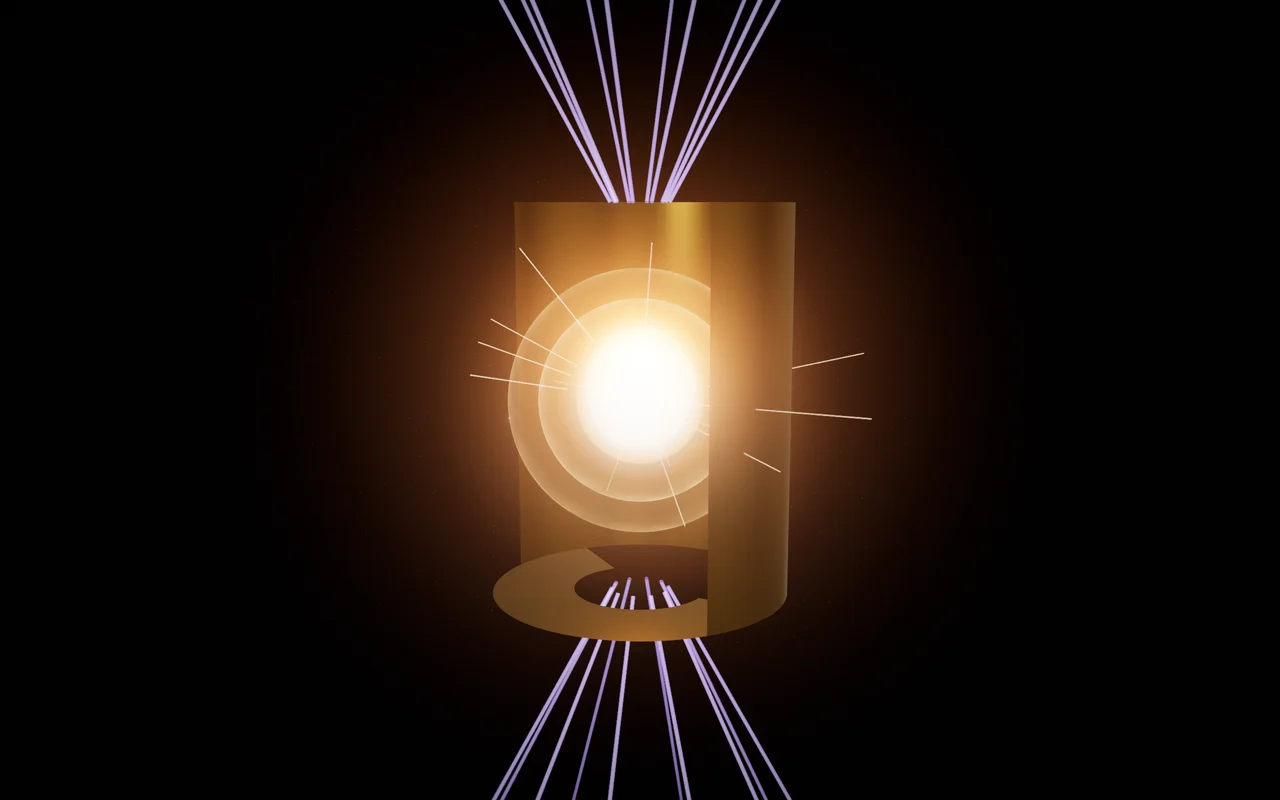
Image: Virtual Lab (3D illustration)
Tokamaks like JET hold plasma with magnetic fields. NIF takes another route: it compresses fuel to enormous density in an instant — inertial confinement fusion. The fuel, a deuterium–tritium mix, sits in a peppercorn-sized capsule with a diamond shell.
The capsule is placed in a small gold cylinder called a hohlraum. 192 laser beams strike its inner walls and fill it with X-rays, which blast off the capsule's surface; the recoil crushes the capsule inward. At the centre the temperature passes 100 million degrees and nuclei begin to fuse.
'Ignition' means the reaction's own heat ignites the rest of the fuel — like a match lighting a whole bonfire. On 5 December that threshold was clearly crossed for the first time: 2.05 MJ of laser energy produced 3.15 MJ, a gain of about 1.5.
Running the lasers, however, took about 300 MJ from the grid, so a power plant is still far off. Even so, the result proved that a process predicted 60 years ago really works. In the following years the experiment was repeated several times with even higher yields.
 Try it in the labPlasma ball3D lab on this site →Share on Telegram
Sources: U.S. Department of Energy · Optica OPN