Juno makes the first close flyby of Ganymede in over 20 years
The flyby took place on 7 June 2021; Juno has orbited Jupiter since 2016.
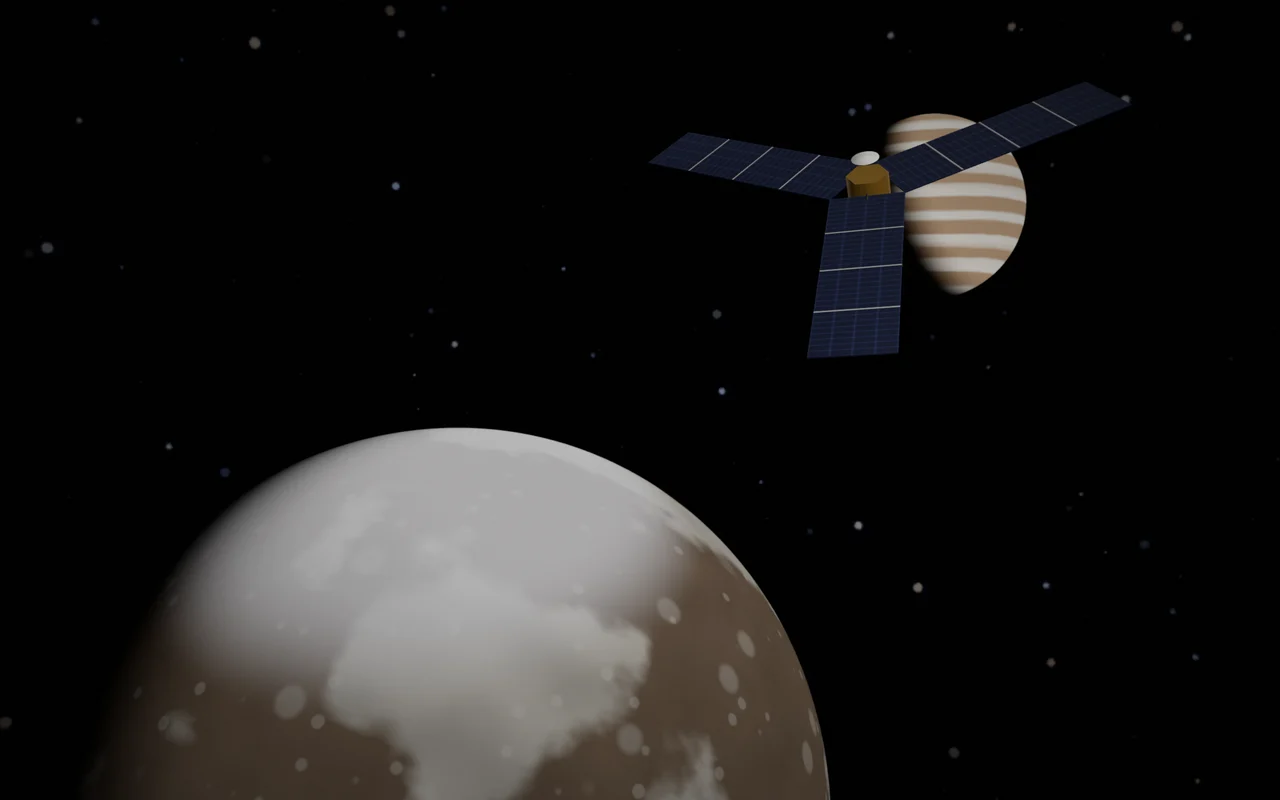
Image: Virtual Lab (3D illustration)
Ganymede is the largest moon in the solar system — 5,268 kilometres across, bigger than the planet Mercury. Discovered by Galileo Galilei in 1610, it is the only moon with its own magnetic field, and beneath its icy crust is thought to lie a salty ocean holding more water than all of Earth's oceans.
Juno is a spinning probe with three large solar panels. It sped past Ganymede at 67,000 kilometres per hour; in that brief window JunoCam imaged almost an entire hemisphere while other instruments probed the icy crust, thin atmosphere and magnetic field.
The images clearly show craters, bright and dark terrain and long linear features resembling tectonic faults on Earth. The navigation camera even captured Ganymede's night side in faint light scattered from Jupiter.
The flyby also reshaped Juno's orbit: Ganymede's gravity cut its period around Jupiter from 53 to 43 days. Juno later made close passes of Europa and Io as well.
 Try it in the labArtificial satellite3D lab on this site →Share on Telegram