The mystery of Betelgeuse's Great Dimming solved: a cloud of dust
The result was published in Nature on 16 June 2021, in work led by Miguel Montargès.
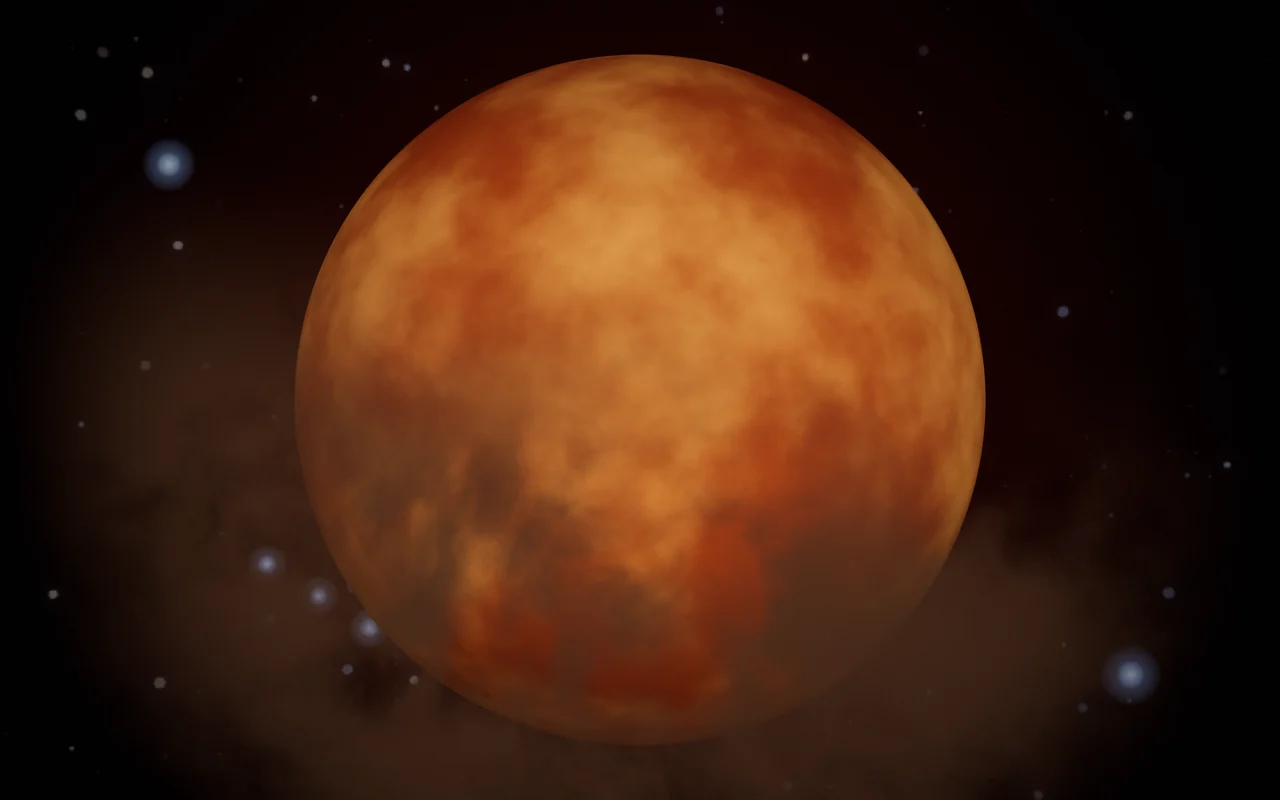
Image: Virtual Lab (3D illustration)
Betelgeuse is one of the brightest stars in the sky — Orion's 'shoulder'. It is so big that, in the Sun's place, it would engulf the orbits of Mercury, Venus, Earth and Mars. Stars like this end their lives as supernovae.
From December 2019 to February 2020 the star's brightness dropped sharply, its southern part especially dark, before recovering by April 2020. Astronomers had two explanations: a cold spot on the surface, or a dust cloud blocking the star.
Montargès's team used the SPHERE instrument on ESO's VLT to see the star's surface as a disc. Four images taken before and during the dimming showed how the surface changed — the only such series ever made.
The answer combined both ideas. Before the dimming the star had ejected a large bubble of gas; when part of its surface cooled, the gas cooled too, condensing into solid dust that partly veiled the star. 'We have directly witnessed the formation of so-called stardust,' says Montargès.
 Try it in the labMelting and boiling3D lab on this site →Share on Telegram
Sources: ESO · Physics World