Home › Nobel Prize laureates › 1996–2005 › 2003
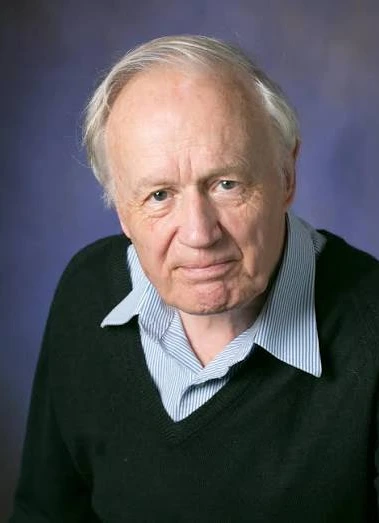
Anthony J. Leggett
1938–2026 · UK / USA
Prize motivation“for pioneering contributions to the theory of superconductors and superfluids”
Shared the prize with: Alexei A. Abrikosov, Vitaly L. Ginzburg
The discovery
A superconductor is a material that loses all electrical resistance at very low temperatures, so a current can flow in it forever without losses. It also pushes magnetic fields out of itself.
In 1950 Vitaly Ginzburg and Lev Landau wrote down equations describing superconductivity. In 1957 Alexei Abrikosov used them to show that a second type of superconductor exists. These keep their superconductivity even in strong fields: the field enters them as thin whirlpool threads that line up in a regular lattice.
In the 1970s Anthony Leggett explained the superfluidity of helium-3, a liquid that flows with no internal friction at very low temperatures. Its atoms join into pairs, and the pairs point in a direction, rather like magnets.
Life
Born on 26 March 1938 in London, he studied classics and philosophy at Oxford before turning to physics, earning his doctorate in 1964.
From 1967 to 1983 he worked at the University of Sussex, England, where he developed his theory of helium-3, and from 1983 he was a professor at the University of Illinois, USA. He died on 8 March 2026.
Where it is used today
Nearly all superconductors used today are type II. They make the powerful magnets in hospital MRI scanners and particle accelerators, including the Large Hadron Collider.
The theories are also used to design fusion-reactor magnets, loss-free power cables and the superconducting circuits of quantum computers.
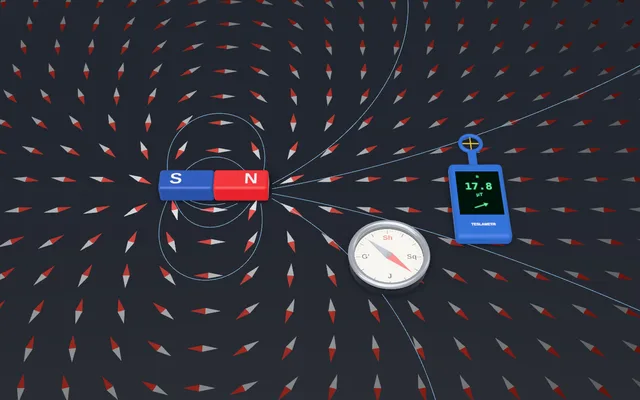 Try it in the labMagnetic field3D lab on this site →Share on Telegram
Sources: NobelPrize.org — 2003 · University of Illinois