Home › Nobel Prize laureates › 1996–2005 › 1999
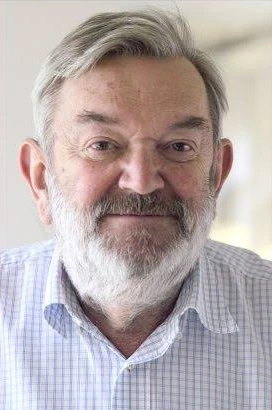
Martinus J.G. Veltman
1931–2021 · Netherlands
Prize motivation“for elucidating the quantum structure of electroweak interactions in physics”
Shared the prize with: Gerardus 't Hooft
The discovery
In the 1960s Glashow, Weinberg and Salam united the electromagnetic and weak forces into a single “electroweak” theory. But whenever anyone tried to calculate precisely with it, meaningless infinite numbers appeared.
At Utrecht University, Martinus Veltman worked on this problem for years. In 1971 his doctoral student Gerard 't Hooft proved that the theory could be “renormalised”: the infinities cancel out and any quantity can be calculated exactly.
The theory could then make numerical predictions. It gave the masses of the W and Z bosons, and later the expected masses of the top quark and the Higgs boson, all of which were later found in experiments.
Life
Born on 27 June 1931 in Waalwijk, the Netherlands, he studied at Utrecht University and earned his doctorate in 1963.
He worked at CERN, was a professor at Utrecht from 1966 to 1981 and then at the University of Michigan in the USA. He died in the Netherlands on 4 January 2021.
Where it is used today
This work turned the Standard Model of particle physics into a precise science; every measurement at CERN's LEP and Large Hadron Collider is compared with calculations made by these methods.
The program Veltman wrote to simplify formulas by computer was one of the first examples of today's computer algebra systems.
Sources: NobelPrize.org — 1999