CERN finds a decay that happens once in ten billion
On 3 November the LHCb collaboration announced evidence for one of the rarest decays ever seen.
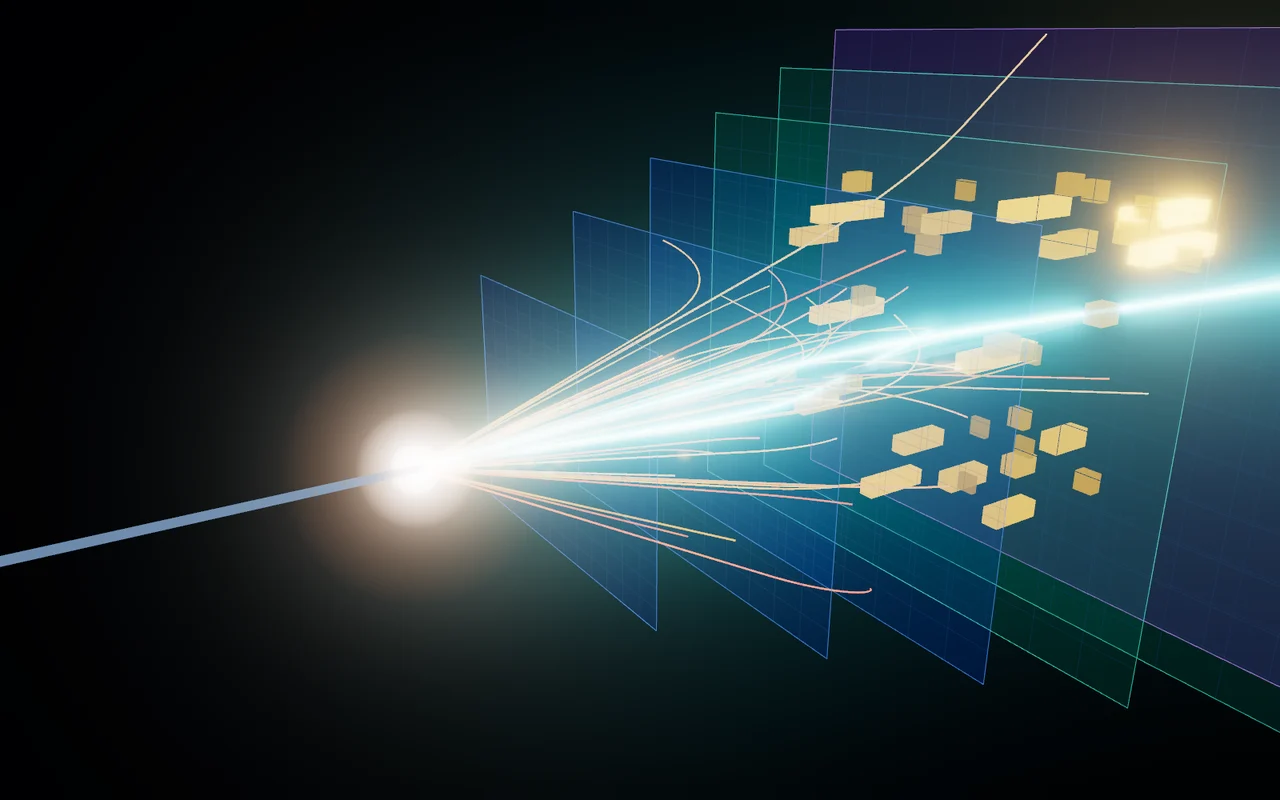
Image: Virtual Lab (3D illustration)
When protons collide at nearly the speed of light in the Large Hadron Collider (CERN, Geneva), many short-lived particles are created. One of them is the B⁰ meson, made of a “beauty” (b) antiquark and a d quark. It usually decays very quickly into other particles, but theory says that in about one case in ten billion it turns into just two particles: a muon and an antimuon.
The search for this decay began in 1984 at the CLEO experiment in the USA, and for 42 years no experiment could see it reliably. Now, using the upgraded LHCb detector and machine-learning methods, scientists have “seen” it for the first time within a single experiment, at a significance of about 3.2 sigma. That counts as “evidence”; a formal discovery needs 5 sigma.
The measured rate is about 1.26 in ten billion, or 1.14 when combined with older data. The Standard Model predicts 1.03 in ten billion, so for now the result agrees with theory.
Why does such a rare process matter? During the decay, particles can briefly and “virtually” involve other, still unknown heavy particles. If those exist, the decay rate shifts slightly from the prediction, so physicists will keep measuring this number ever more precisely.
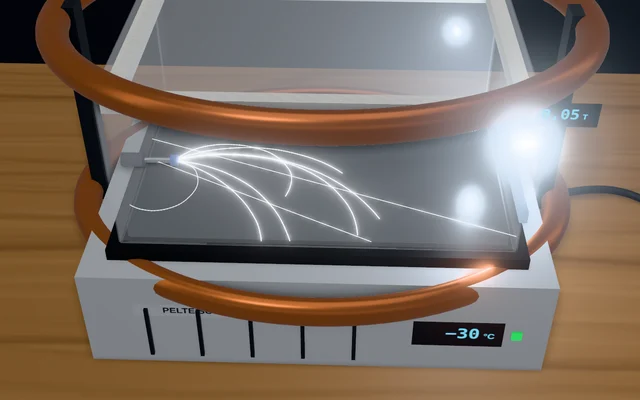 Try it in the labCloud chamber3D lab on this site →Share on Telegram