A 'galaxy' with no stars: Cloud-9, a gas cloud held by dark matter
The result was announced on 5 January 2026 at the 247th meeting of the American Astronomical Society and published in The Astrophysical Journal Letters; the lead author is Gagandeep Anand of STScI.
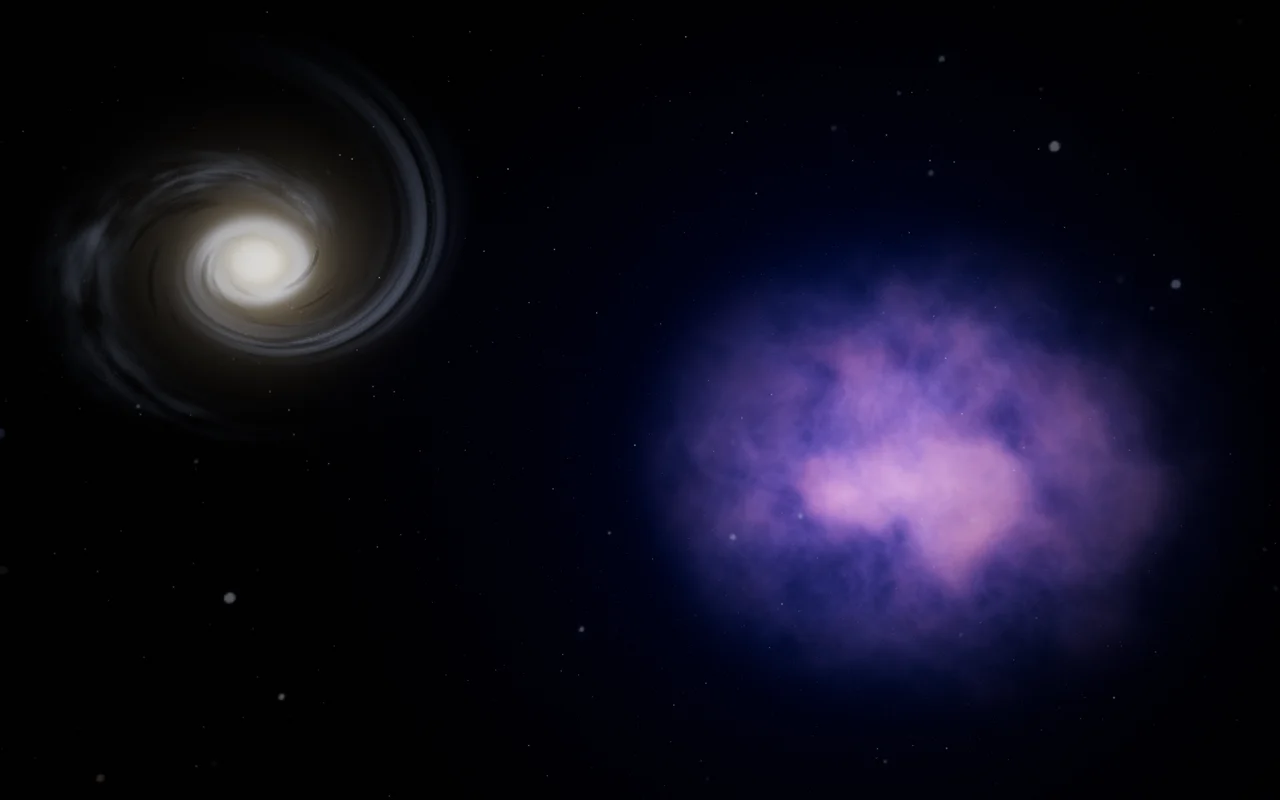
Image: Virtual Lab (3D illustration)
Cloud-9 lies 14 million light years away, next to the spiral galaxy Messier 94. It was first found by China's 500-metre FAST radio telescope: neutral hydrogen emits radio waves at a wavelength of 21 cm, and those gave the cloud away. The Green Bank Telescope and the VLA in the United States later confirmed it. The name is simple — it was the ninth gas cloud found around M94.
The open question was whether it might just be a faint dwarf galaxy whose stars were too dim for ground-based telescopes. Hubble's Advanced Camera for Surveys settled it: it found no stars inside the cloud, only distant background galaxies within its boundaries.
The cloud's hydrogen core is about 4,900 light years across, yet the gas weighs only about a million Suns — far too little to hold itself together. Assuming the gas pressure is balanced by gravity, the team worked out the invisible mass inside: about 5 billion solar masses. The cloud is held together almost entirely by dark matter.
Such objects are called RELHICs: dark-matter clouds whose gas never collapsed into stars after the universe was reionised. Had Cloud-9 been much heavier, its gas would have collapsed and formed stars; much lighter, and the gas would have escaped. It sits right in the sweet spot. As principal investigator Alejandro Benitez-Llambay puts it, the team has found 'a primordial building block of a galaxy that hasn't formed'.
 Try it in the labGas laws3D lab on this site →Share on Telegram
Sources: ESA/Hubble · NASA