A quantum sensor that cells build themselves: a protein qubit
Published in Nature in August, the work made Physics World's Top 10 Breakthroughs of the Year.
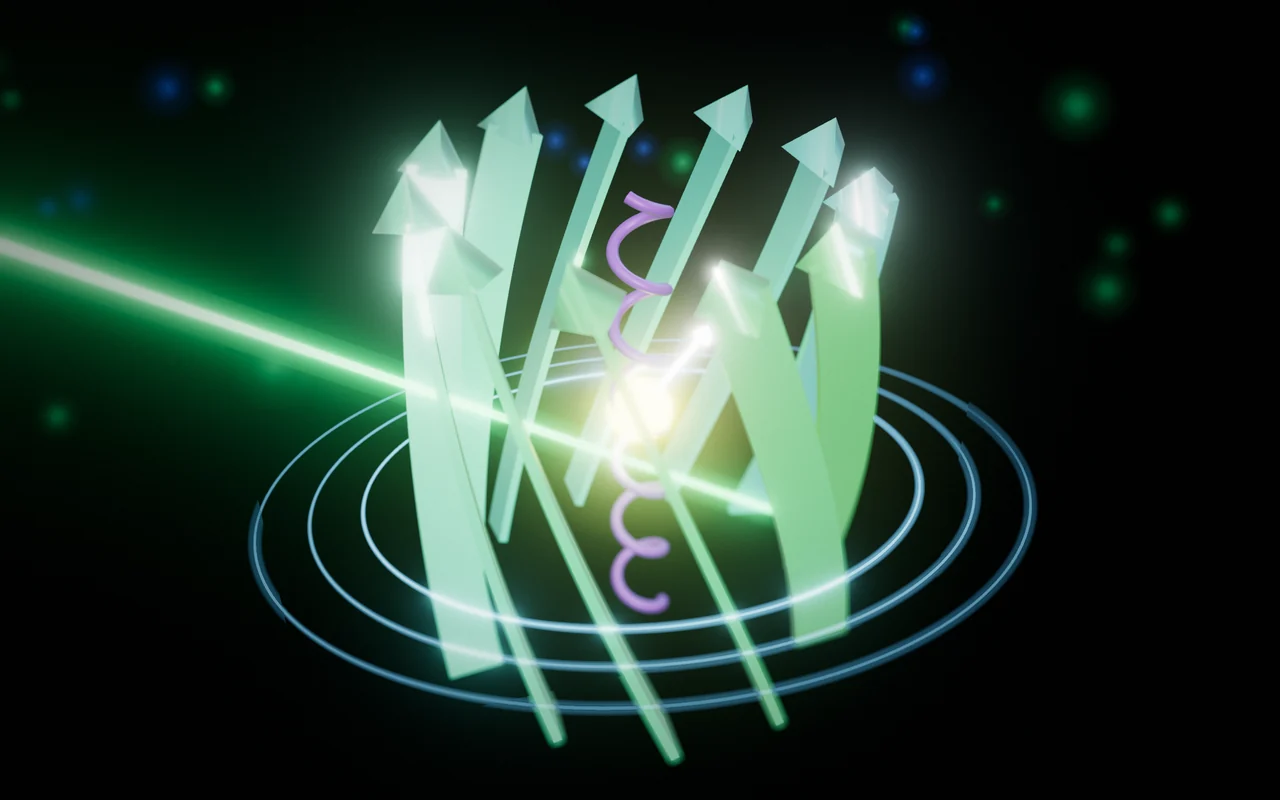
Image: Virtual Lab (3D illustration)
Quantum technologies usually need very cold, quiet conditions, while a living cell is warm, wet and always moving, so biology and quantum physics have seemed incompatible.
Biologists have used fluorescent proteins for decades: they can be genetically written into exactly the right place and glow under the microscope to reveal what happens inside a cell. These proteins are only about 3 nanometres across.
A team led by Peter Maurer and David Awschalom made use of a special quantum state in enhanced yellow fluorescent protein (EYFP). They developed a new way to control and read out its spin with a laser, turning the protein into a light-controlled qubit, and used it inside mammalian cells.
The authors stress that cells make these protein qubits themselves and place them with atomic precision. In future they could measure magnetic fields and temperature inside cells and enable MRI at the level of a single cell or even a single molecule.
 Try it in the labPhotocolorimetry3D lab on this site →Share on Telegram
Sources: University of Chicago · Physics World