Humanity sees the Sun's pole for the first time
The images were taken in March 2025 and released by ESA on 11 June.
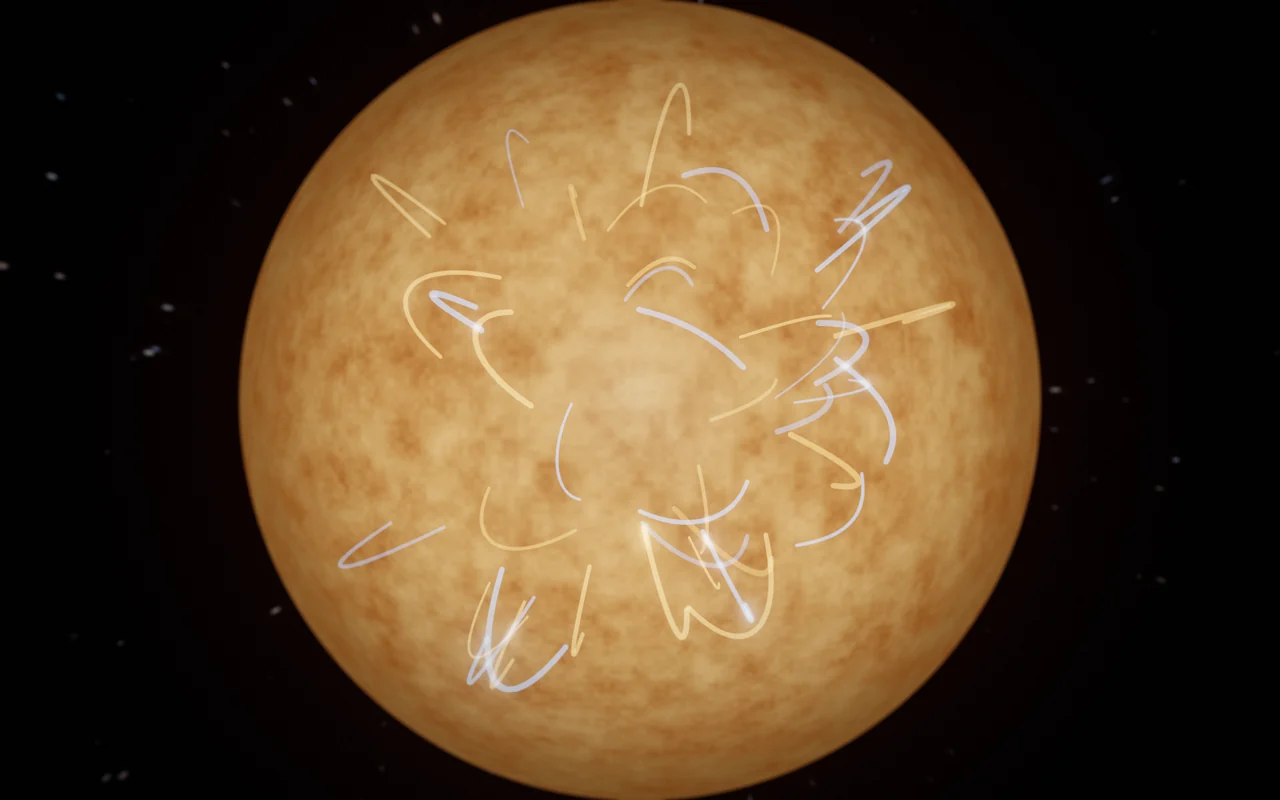
Image: Virtual Lab (3D illustration)
Earth and the other planets orbit the Sun in almost the same plane, so we always see the Sun from near its equator; its poles had never been viewed directly. It's like only ever looking at a globe from the side.
Solar Orbiter launched in February 2020. In February 2025 it flew past Venus and used its gravity to tilt its orbit. In March the probe reached 15 and then 17 degrees below the solar equator — enough to see the south pole.
Using about ten instruments, it imaged the pole in visible and ultraviolet light. The most striking finding: north and south magnetic polarities are jumbled together at the pole, whereas normally one direction dominates each pole.
That's because the Sun is at the peak of its 11-year cycle, when its magnetic poles swap places and the field turns chaotic. Solar Orbiter will tilt further — to 24 degrees in December 2026 and 33 degrees in 2029.
 Try it in the labMagnetic field3D lab on this site →Share on Telegram
Sources: Astronomy · ScienceDaily / ESA