The most energetic neutrino ever caught, deep under the sea
The KM3NeT collaboration published the result in Nature on 12 February 2025; the event itself was recorded on 13 February 2023.
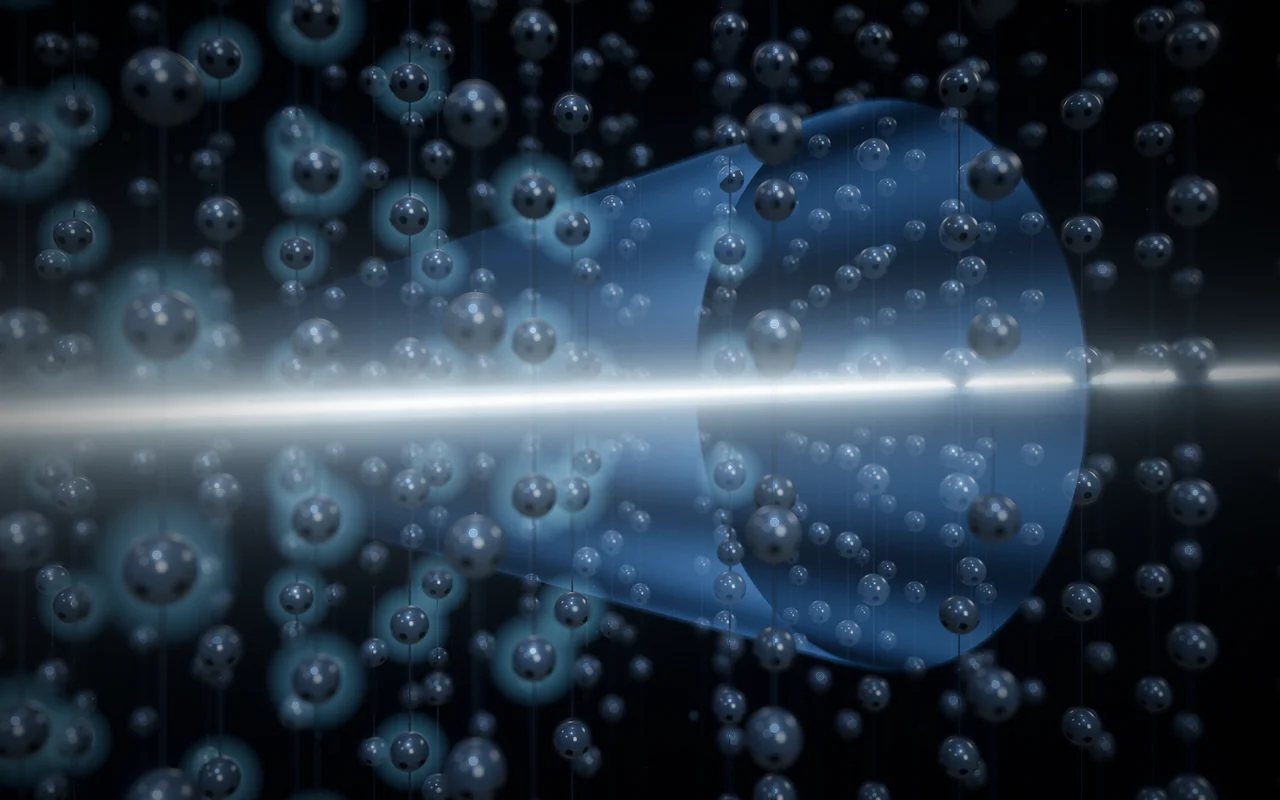
Image: Virtual Lab (3D illustration)
The neutrino is a 'ghost particle': it barely interacts with anything, and billions pass through our bodies every second unnoticed. Catching one takes a huge, dark, transparent volume — ice or seawater.
KM3NeT is a neutrino telescope being built on the Mediterranean seabed. Its ARCA section lies off Sicily, 3.5 km down. Thousands of light sensors hang on hundreds of vertical 'strings'. When a neutrino strikes an atom in the water or rock, it creates a fast charged particle such as a muon, which emits faint bluish Cherenkov light in the water.
On 13 February 2023 the detector recorded an almost horizontal muon with about 120 PeV of energy — so powerful that the first sensors were saturated. Calculations suggest the neutrino that produced it carried about 220 PeV.
The team spent two years checking the signal before announcing it. The previous record, about 10 PeV, belonged to IceCube in Antarctica. Remarkably, the telescope is only about 10% complete.
 Try it in the labCloud chamber3D lab on this site →Share on Telegram
Sources: Physics Today · Nature (DOI)