Winds of 33,000 km/h measured on a distant planet
The study, led by Lisa Nortmann of the University of Göttingen, was published in Astronomy & Astrophysics on 21 January 2025.
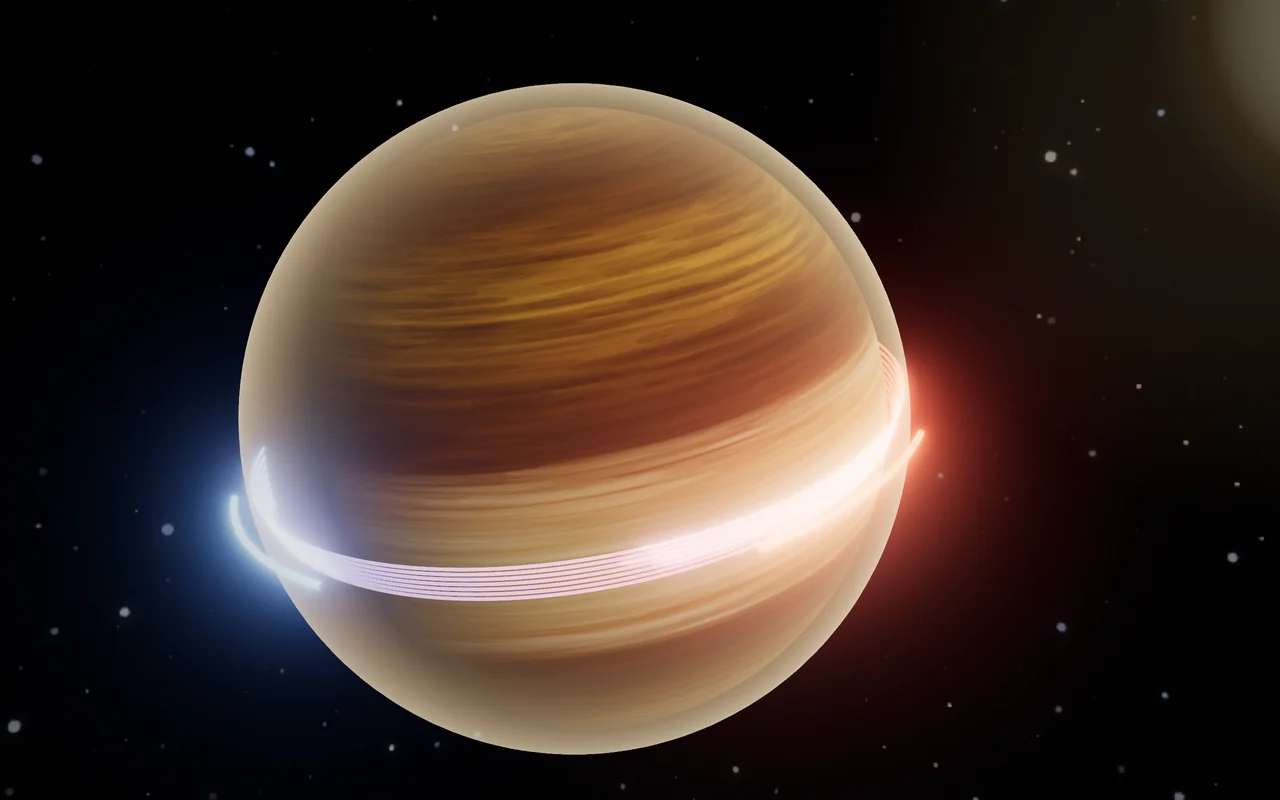
Image: Virtual Lab (3D illustration)
WASP-127b is a gas giant discovered in 2016. It orbits very close to its star and is extremely 'puffy' — larger than Jupiter but much lighter. Starlight shines readily through the atmospheres of such planets, so their weather can be studied.
When the planet passes in front of its star, some starlight filters through its atmosphere. Using the CRIRES+ instrument on ESO's Very Large Telescope in Chile, the team analysed that light in great detail, confirming water vapour and carbon monoxide.
The surprise was that every spectral line was split in two. This is the Doppler effect: one part of the atmosphere is moving towards us and another away at the same speed. The calculation revealed an equatorial jet of about 9 km/s — 33,000 km/h — nearly six times faster than the planet spins.
The team also found the poles are cooler than the rest of the planet, with a temperature difference between its morning and evening sides. For comparison, the fastest wind in our solar system, on Neptune, blows at 'only' 1,800 km/h.
 Try it in the labThe Doppler effect3D lab on this site →Share on Telegram
Sources: ESO · ScienceDaily