2024 Nobel Prize: the physics that opened the way to artificial intelligence
The Royal Swedish Academy of Sciences announced the prize on 8 October 2024.
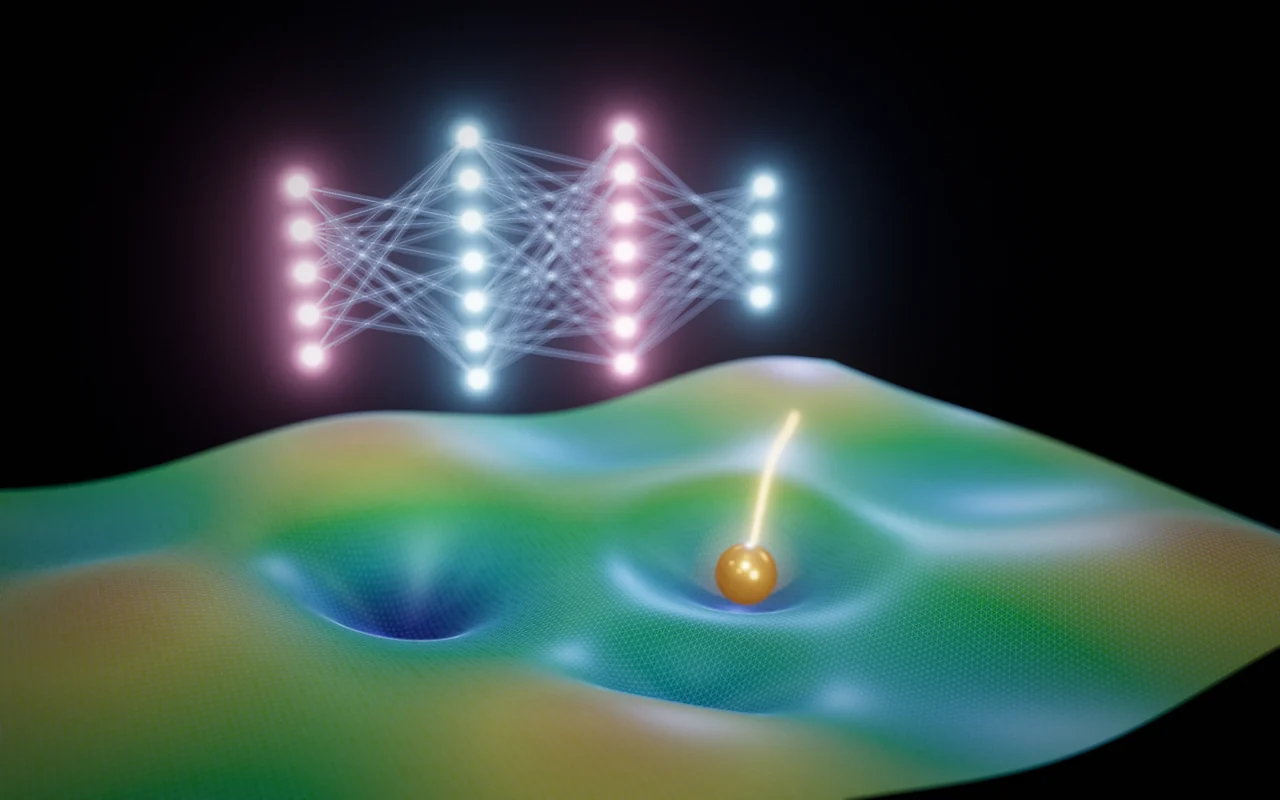
Image: Virtual Lab (3D illustration)
An artificial neural network is inspired by the brain: its 'nodes' act as neurons and the connections between them as synapses. The network learns from examples — connections between nodes that are active at the same time grow stronger.
In 1982 John Hopfield created a network that stores and reconstructs images. It draws on the physics of materials in which every atom is a tiny magnet. Fed a distorted picture, the network lowers its 'energy' step by step until it reaches the most similar stored image — like a ball rolling to the bottom of a valley.
Geoffrey Hinton built on this idea to create the 'Boltzmann machine', based on statistical physics, the science of systems made of many similar parts. Such a network can discover characteristic features in data on its own — recognising objects in pictures, for example, or generating new examples of the kind it has learned.
From the 1980s onward, this work paved the way for today's boom in artificial intelligence. Physicists use neural networks widely too: to search for new materials, analyse telescope data and sift through collisions at particle accelerators.
 Try it in the labArduino projects3D lab on this site →Share on Telegram
Sources: Nobel Prize · AIP