CERN sees quantum entanglement in the heaviest known particles
The ATLAS result was published in Nature on 18 September 2024; the CMS experiment confirmed it.
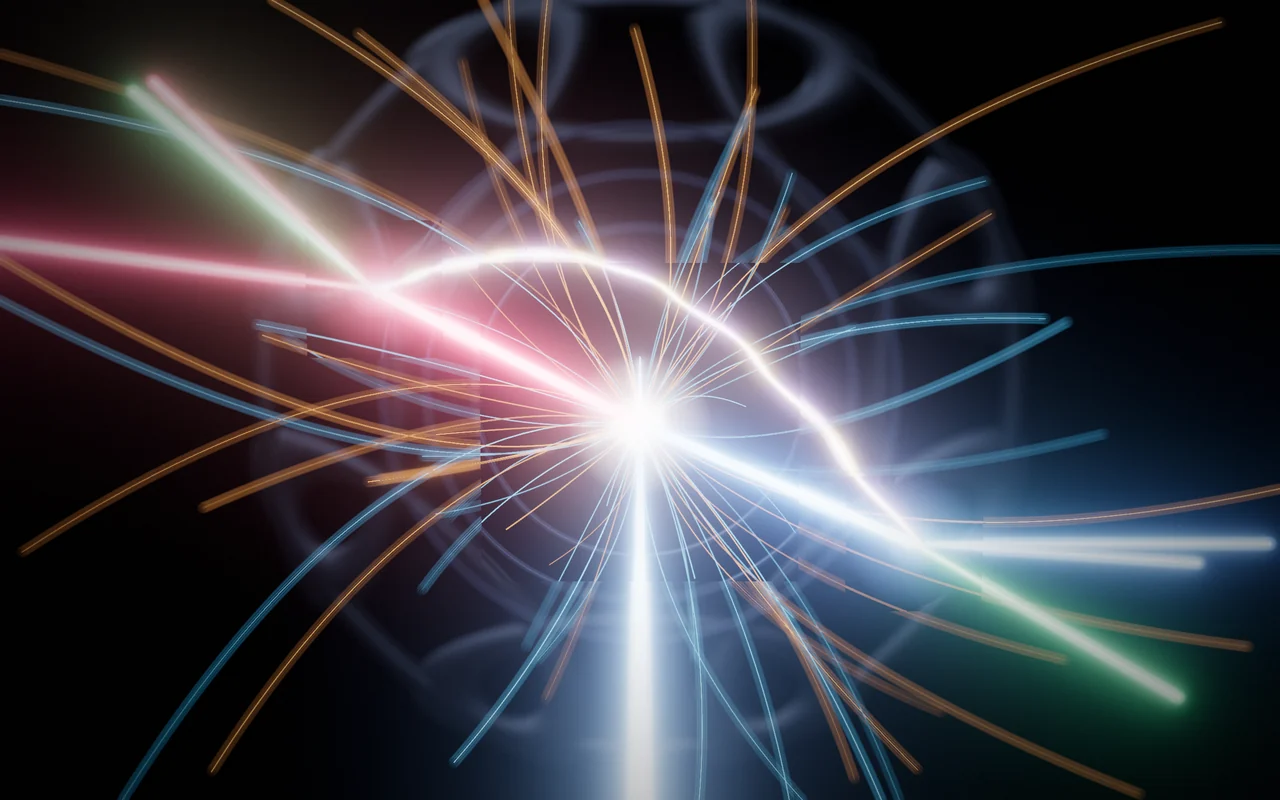
Image: Virtual Lab (3D illustration)
When two particles are entangled, the state of one is tied to the other no matter how far apart they are. This underpins quantum computing and quantum cryptography; the 2022 Nobel Prize was awarded for experiments with entangled photons.
Entanglement had been seen in photons, atoms and superconducting circuits, but it was largely unexplored at the enormous energies of particle colliders.
The top quark is the heaviest elementary particle, with a mass close to that of a gold atom. It decays so quickly (in about 10⁻²⁵ seconds) that information about its 'spin' passes straight to its decay products. ATLAS physicists selected top-quark pairs from 13 TeV proton collisions and measured the angle between the electrons and muons they produced.
The entanglement marker D came out at −0.537 ± 0.019; for unentangled pairs it would have to be above −1/3. The significance exceeds five standard deviations — the 'discovery' level in physics. The CMS experiment independently reached the same conclusion.
 Try it in the labCloud chamber3D lab on this site →Share on Telegram
Sources: Nature (DOI) · IFAE / CERN