Gaia BH3: the Milky Way's most massive stellar black hole
The discovery was published in Astronomy & Astrophysics on 16 April 2024.
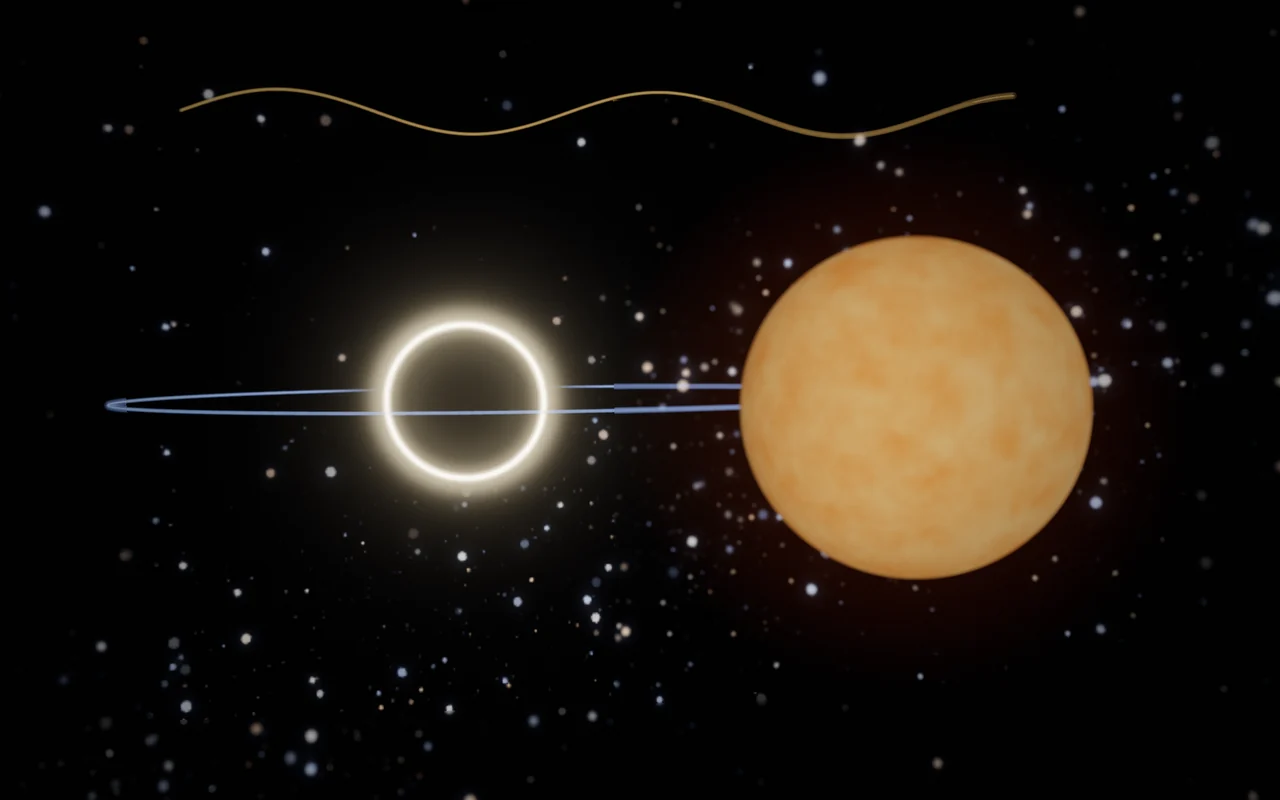
Image: Virtual Lab (3D illustration)
Since 2013, the Gaia telescope has been measuring the positions and motions of billions of Milky Way stars with extreme precision. While checking a new batch of data, scientists noticed an old giant star in Aquila that was 'wobbling' strangely.
The star turned out to orbit an invisible companion every 11.6 years. From the orbit's size and speed, the companion's mass was calculated at 33 times that of the Sun. Something that heavy yet completely dark can only be a black hole.
The previous record-holder in our galaxy was Cygnus X-1, at 21 solar masses; most stellar black holes weigh about 10. Gaia BH3 is also the second-closest known black hole to Earth.
The companion star formed within the first 2 billion years after the Big Bang and contains very few heavy elements. That suggests the star that became the black hole was similarly 'metal-poor'. Such stars lose little mass during their lives and can leave heavy black holes behind.
 Try it in the labArtificial satellite3D lab on this site →Share on Telegram
Sources: ESA · Leibniz Institute for Astrophysics Potsdam