CERN laser-cools a matter–antimatter atom for the first time
The result was published in Physical Review Letters on 22 February 2024; a University of Tokyo team independently cooled positronium too.
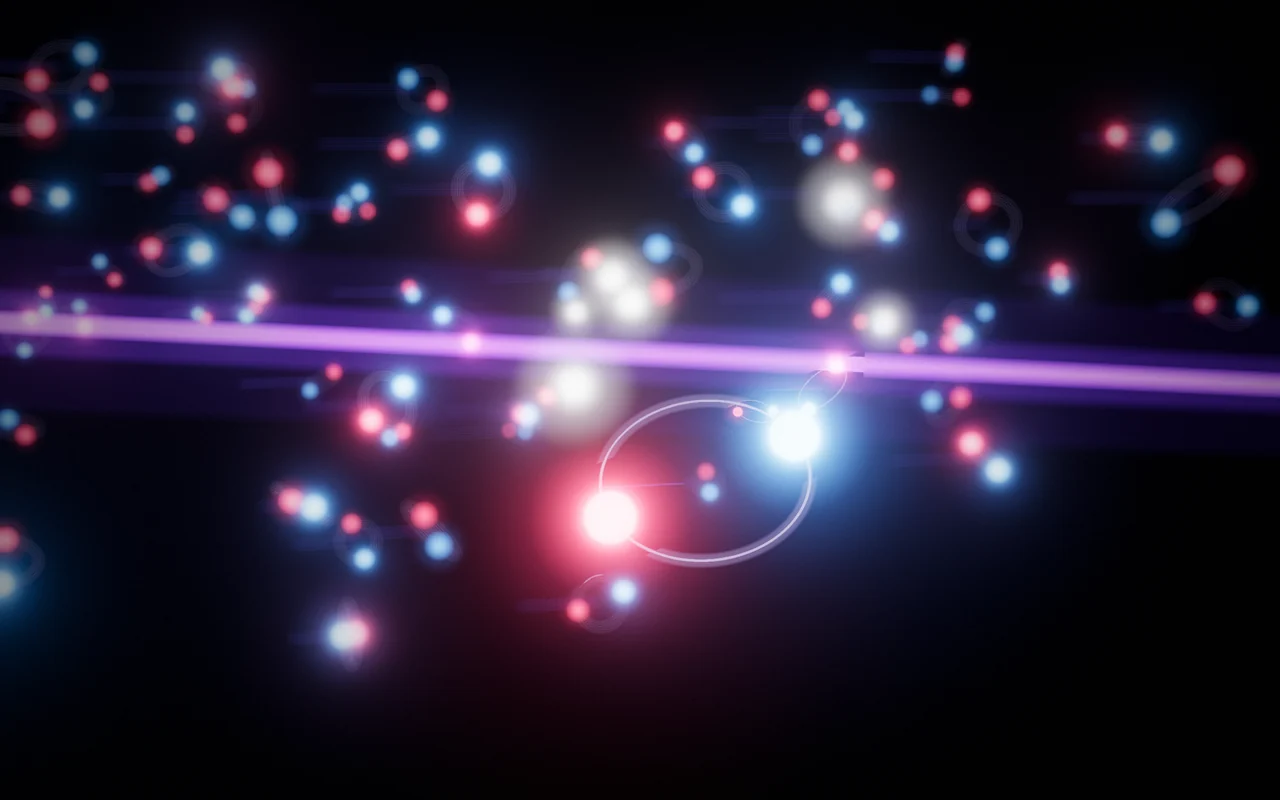
Image: Virtual Lab (3D illustration)
Positronium is hydrogen's 'little brother': a positron takes the place of the proton, so it is about 2,000 times lighter. But it is unstable — the electron and positron soon annihilate into light. In vacuum, positronium lives only 142 nanoseconds.
In laser cooling, photons coming head-on 'kick' an atom and slow it down. Positronium lives so briefly that doing this was extremely hard. The idea was first proposed in 1988.
The AEgIS team built a special alexandrite laser emitting 243-nanometre ultraviolet light. Its pulses are intense, broadband and long, so a large fraction of the atoms in the cloud is cooled at once.
The cloud's temperature dropped from 380 to 170 kelvin, and the atoms' sideways speed fell from 54 to 37 km/s. A University of Tokyo team also cooled positronium using a different approach.
 Try it in the labAtomic spectra3D lab on this site →Share on Telegram
Sources: Physical Review Letters · CERN Courier