Gravity measured on the smallest mass yet
The work by scientists from Southampton, Leiden and Italy was published in Science Advances in February 2024.
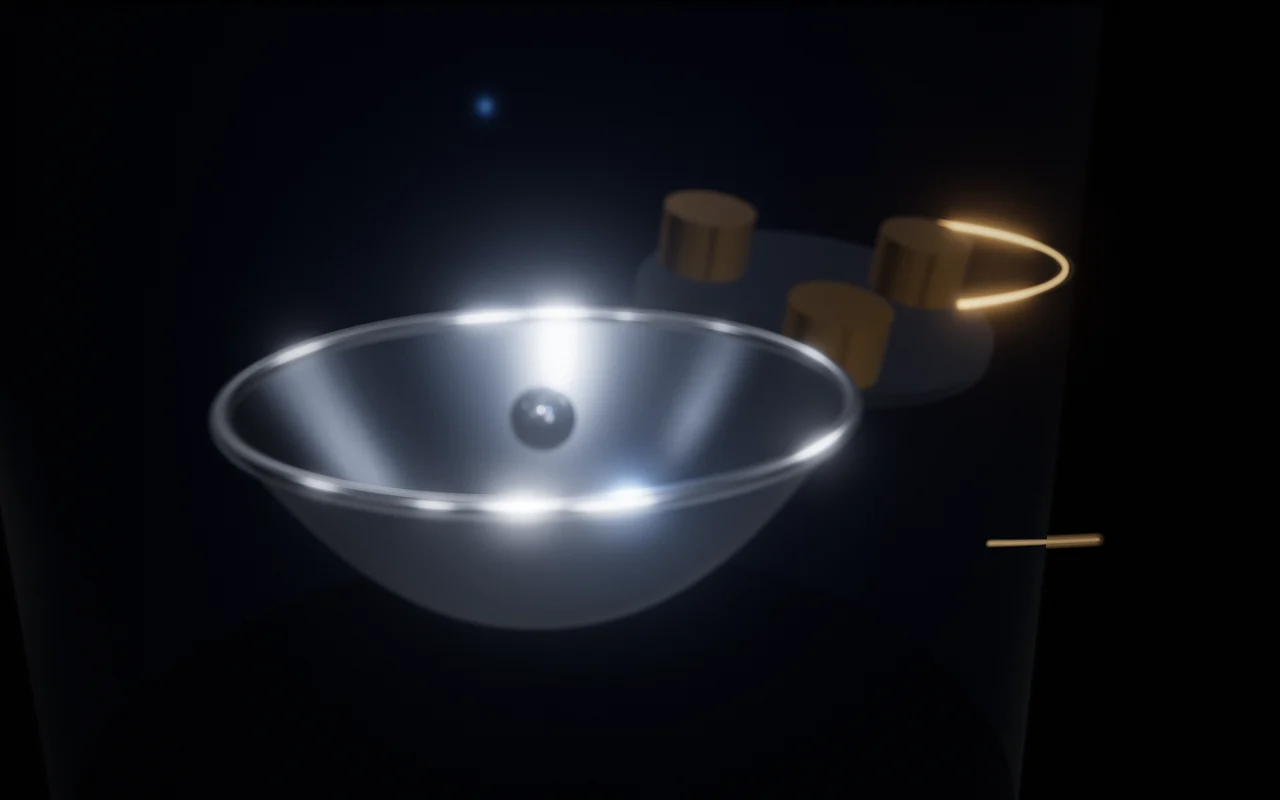
Image: Virtual Lab (3D illustration)
Physics has two great theories: general relativity explains gravity and large bodies, while quantum mechanics describes atoms and particles. For a century, nobody has managed to unite them into a theory of 'quantum gravity'.
One problem is that gravity is extremely weak. The pull between small objects is so faint that vibrations and electric or magnetic forces easily drown it out, so measuring gravity at scales approaching the quantum world is very hard.
Tim Fuchs's team placed a 0.43 mg magnetic particle in a tantalum trap. Once the trap became superconducting, the particle floated without touching anything. The whole set-up was cooled to a hundredth of a degree above absolute zero and isolated from vibrations by springs.
A mass of about a kilogram was moved around nearby to create a periodic gravitational tug. The team detected the particle swaying under a force of 30 attonewtons (3×10⁻¹⁷ N) — one of the smallest masses on which gravity has ever been measured.
 Try it in the labFree fall3D lab on this site →Share on Telegram
Sources: University of Southampton · ScienceDaily