The first programmable quantum processor with 48 logical qubits
The result was published in Nature on 6 December 2023, in work led by Mikhail Lukin of Harvard University.
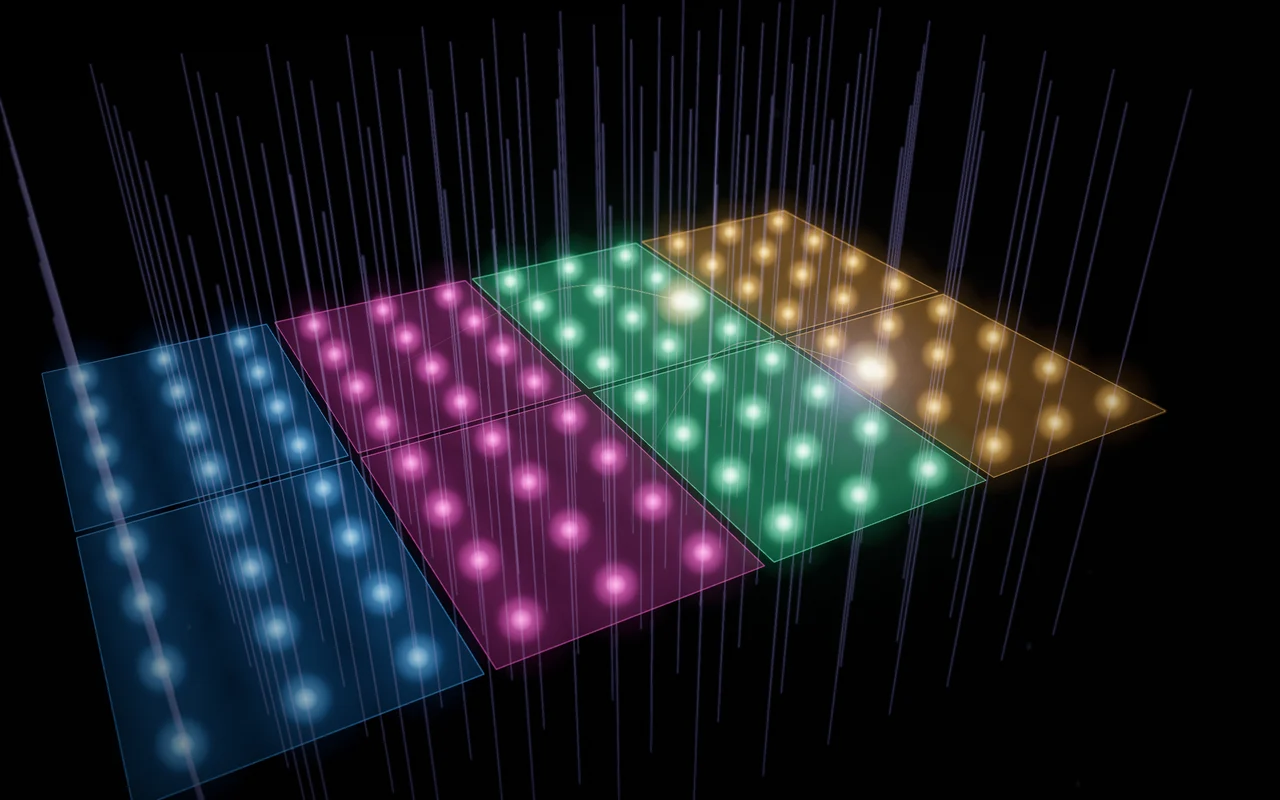
Image: Virtual Lab (3D illustration)
The basic element of a quantum computer is the qubit, which can be in a superposition of 0 and 1. But qubits are fragile — the slightest disturbance corrupts their information — so several physical qubits are combined into one 'logical qubit' that detects and corrects its own errors.
The Harvard team used ultracold rubidium atoms in a vacuum chamber, each held in an optical 'tweezer' made of laser light. The atoms can be moved around by lasers, so any qubit can be linked to any other.
Qubits are linked by exciting atoms into Rydberg states, in which an electron is lifted very far from the nucleus. The team grouped atoms into logical qubits and ran hundreds of logical operations on them.
Crucially, computations on the logical qubits were more accurate than on physical ones — error correction genuinely helped. Forty-eight logical qubits was a record at the time. Mikhail Lukin noted that the work built on rapid progress across the neutral-atom quantum computing community.
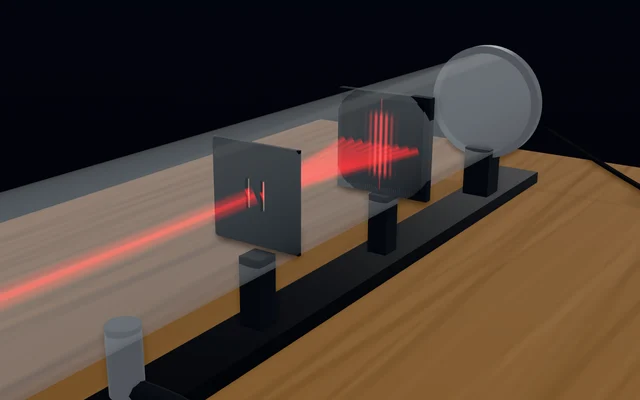 Try it in the labQuantum interference3D lab on this site →Share on Telegram
Sources: Harvard OTD · Physics World