'Amaterasu': a mysterious ultra-high-energy particle from space
The Telescope Array collaboration published the result in Science on 23 November 2023; the particle was recorded on 27 May 2021 and first noticed by Toshihiro Fujii of Osaka Metropolitan University.
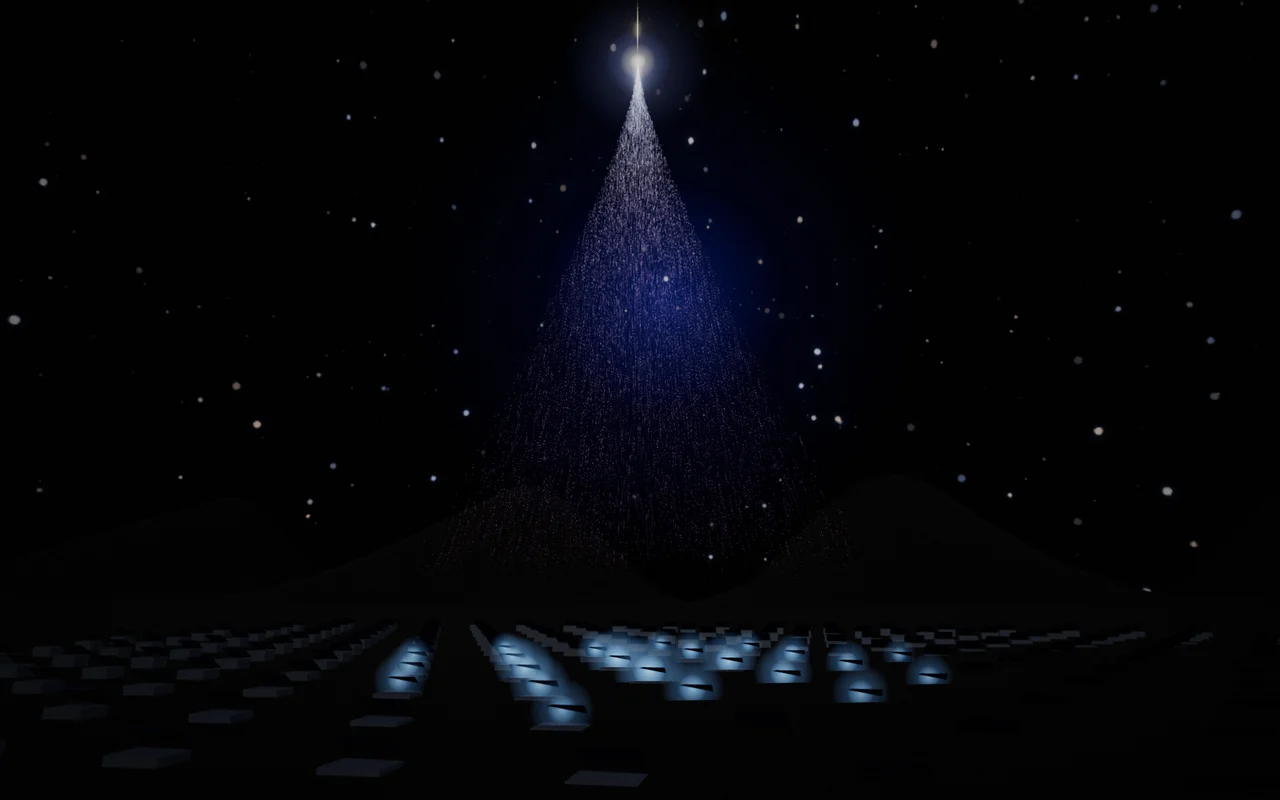
Image: Virtual Lab (3D illustration)
Cosmic rays are charged particles, mostly atomic nuclei, that rain down on Earth from space. The most energetic are extremely rare — about one per square kilometre per century. When one hits the atmosphere it triggers a 'shower' of billions of secondary particles spreading over kilometres of ground.
The Telescope Array consists of 507 surface detectors spread over 700 square kilometres of the Utah desert, catching shower particles to reconstruct the original particle's energy and direction. On 27 May 2021, 23 detectors fired at once, revealing a particle of about 244 EeV — roughly 40 joules.
It is the second most energetic cosmic particle ever recorded. The record still belongs to the 'Oh-My-God' particle detected in Utah in 1991, at 320 EeV. Forty joules is enormous for a single elementary particle — about the energy of a falling brick hitting the ground.
Most intriguing, no known source capable of such energies lies in the direction it came from: it arrived from the Local Void, a region almost empty of galaxies. Perhaps galactic magnetic fields bent it more than expected — or unknown physics is at play.
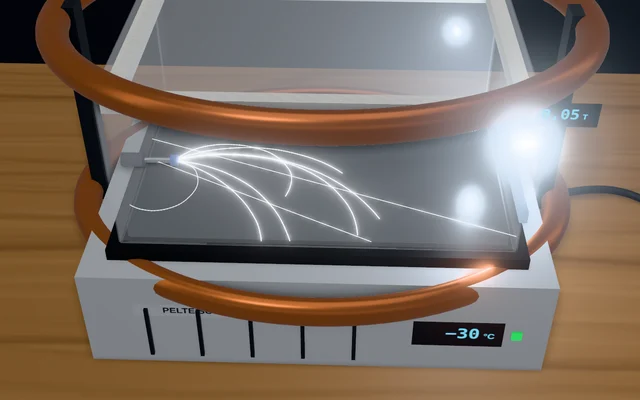 Try it in the labCloud chamber3D lab on this site →Share on Telegram
Sources: Osaka Metropolitan University · Science (DOI)