The Milky Way seen in neutrinos for the first time
The IceCube collaboration published the result in Science on 29 June 2023.
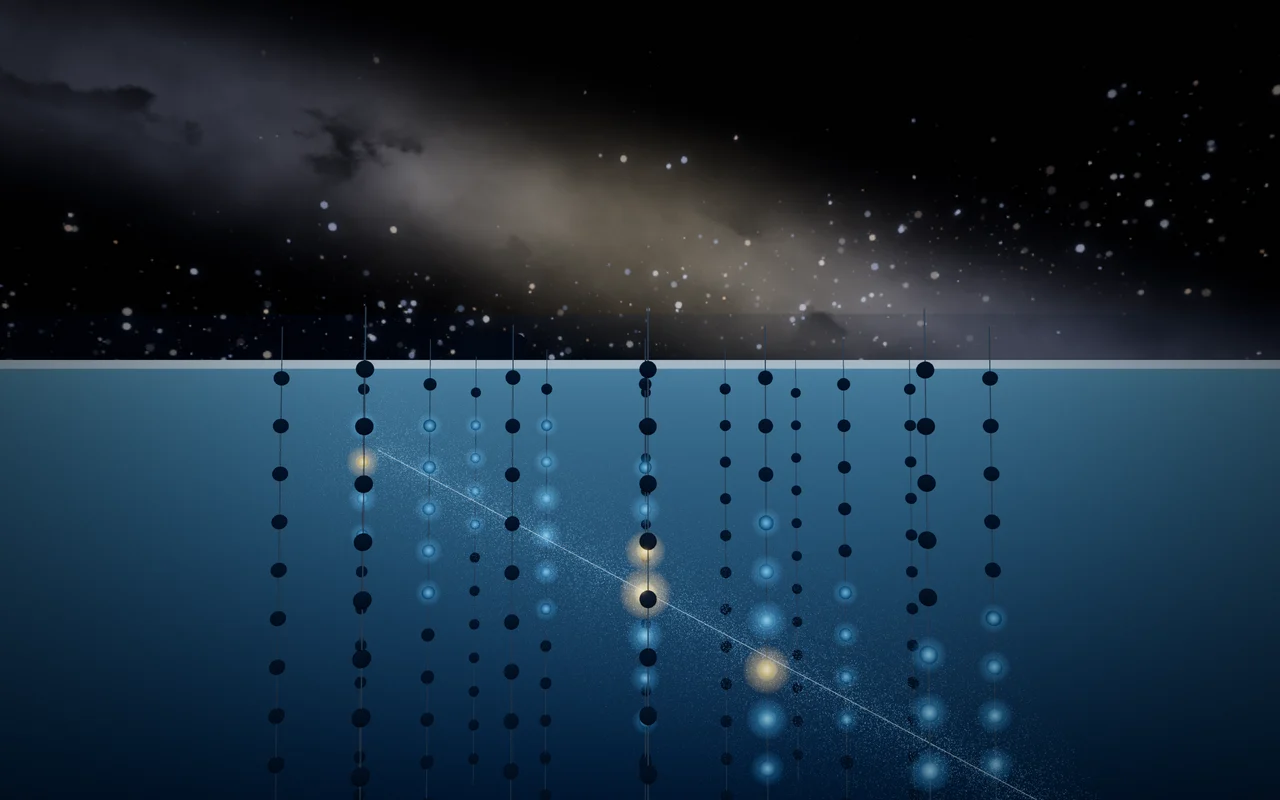
Image: Virtual Lab (3D illustration)
IceCube is a huge detector at the South Pole, frozen into the ice 1.5–2.5 km down. It fills a cubic kilometre of ice holding more than 5,000 light sensors. When a neutrino hits an atom in the ice it creates a fast charged particle that travels faster than light does in ice, emitting bluish Cherenkov light.
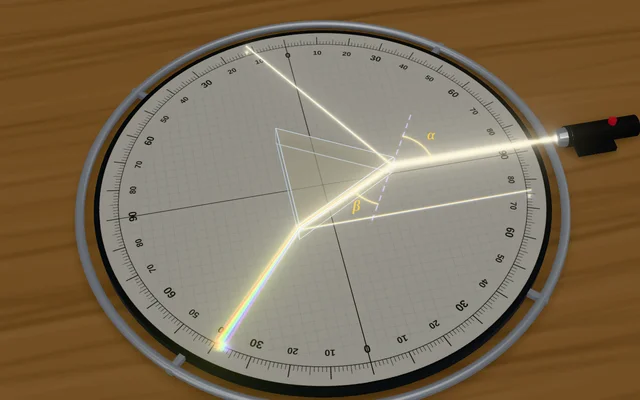
Light is slower in ice than in vacuum because ice's refractive index is greater than one. A particle outrunning it produces a cone of light, much like the shock wave of a supersonic jet, and the sensors use that light to work out where the neutrino came from.
Neutrinos from our own galaxy are especially hard to find because they are swamped by the many neutrinos made in Earth's atmosphere. Using machine-learning methods, the team selected nearly 60,000 events from ten years of data and found a signal from the plane of the Milky Way.
The signal has a significance of 4.5 standard deviations. Such neutrinos are thought to form when cosmic rays collide with gas in the galaxy. The signal matches diffuse emission along the galactic plane, though it could also come from many sources not yet resolved individually.
 Try it in the labRefraction of light3D lab on this site →Share on Telegram
Sources: Science (DOI) · Cosmos