First X-ray signature of a single atom
The result was published in Nature on 31 May 2023 and made the journal's cover; the work was led by Saw-Wai Hla of Ohio University and Argonne National Laboratory.
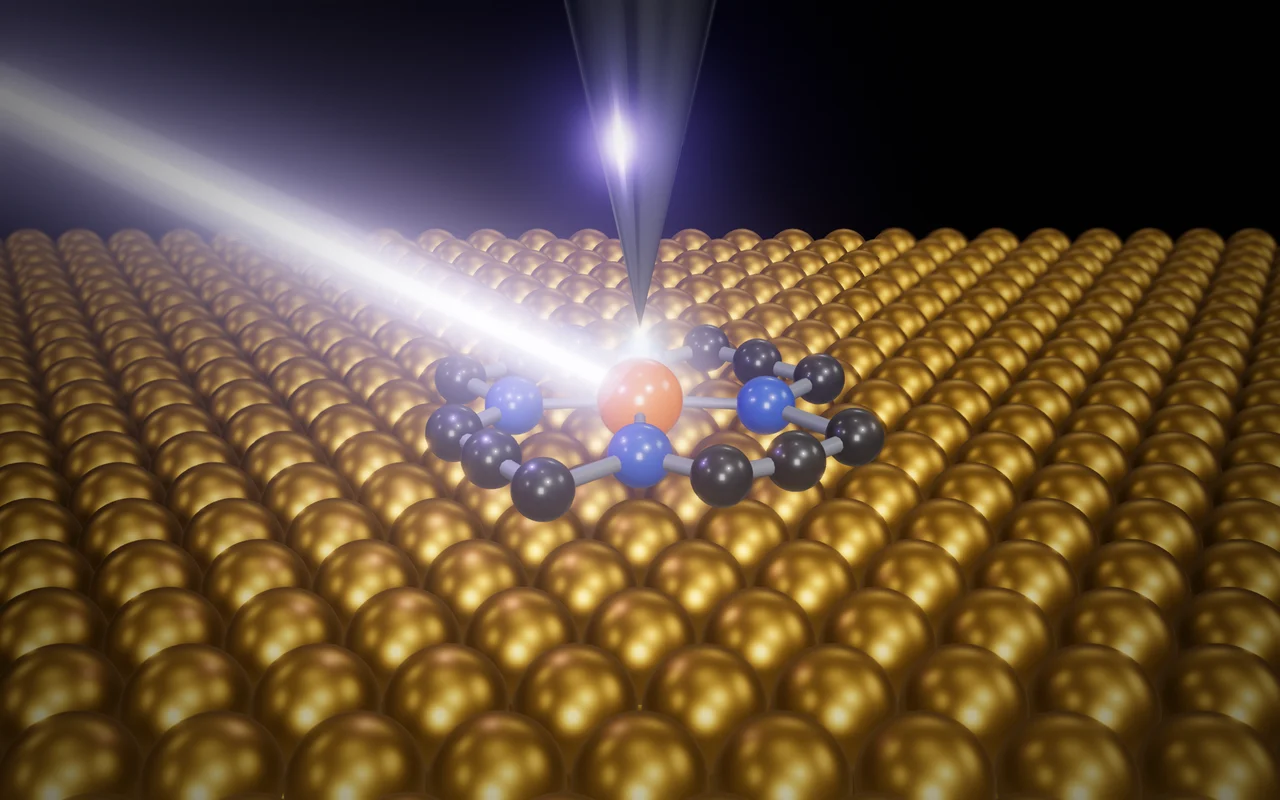
Image: Virtual Lab (3D illustration)
X-rays have been used since 1895 for everything from medicine to airport security, and in science they are the main tool for identifying what a material is made of. But the X-ray signal from a single atom is so weak that ordinary detectors miss it, so the smallest sample was about an attogram — roughly 10,000 atoms.
A scanning tunnelling microscope can 'see' atoms but cannot say which element they are. Saw-Wai Hla's team spent 12 years combining the two approaches into a new technique: synchrotron X-ray scanning tunnelling microscopy.
When X-rays strike an atom, its inner electrons are excited. A sharp metal tip held extremely close to the sample collects these electrons thanks to quantum tunnelling. The experiment was carried out on a dedicated beamline of Argonne's Advanced Photon Source synchrotron.
The samples were a single iron atom and a single terbium atom, each embedded in a host molecule. The team identified each element and also measured its chemical state, finding that the iron atom bonds actively with its surroundings while the terbium stays relatively isolated.
 Try it in the labX-rays3D lab on this site →Share on Telegram
Sources: Ohio University · Nature (DOI)