Neutrinos made in a collider detected for the first time
The result was announced on 19 March 2023 at the Moriond conference in Italy and published in Physical Review Letters in July.
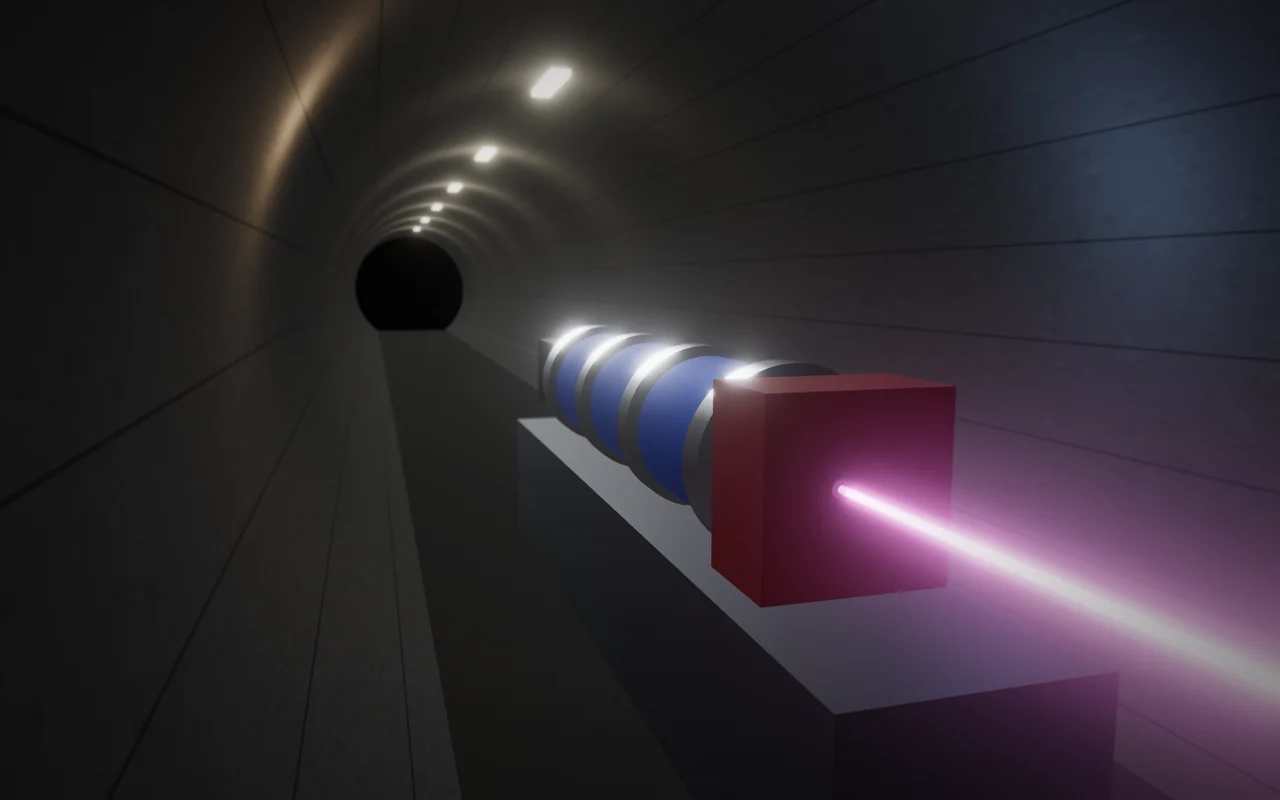
Image: Virtual Lab (3D illustration)
The neutrino was discovered in 1956, and since then neutrinos from the Sun, reactors, the atmosphere and space have all been studied. Colliders also produce huge numbers of neutrinos, but none had ever been caught directly; their presence was inferred only from 'missing' energy and momentum.
The reason is simple: the most energetic neutrinos fly almost straight ahead along the beam line, exactly where the big detectors cannot look because the beam passes there. FASER was built to fill that gap.
Only about 5 metres long, FASER sits in an underground tunnel 480 metres from the ATLAS detector, right on the beam axis. Rock and iron in between stop other particles while neutrinos pass freely. Occasionally a neutrino strikes the detector material and produces a muon, whose track is recorded.
The 2022 data contained 153 such events, at a significance of 16 standard deviations — far above the 5 needed for a discovery. The neutrino energies were well above 200 GeV, and the detector even recorded its first electron-neutrino candidate.
 Try it in the labCloud chamber3D lab on this site →Share on Telegram
Sources: CERN Courier · Physical Review Letters (DOI)