Humanity changes an asteroid's orbit for the first time: DART results
The results appeared on 1 March 2023 in five papers in Nature; the main measurement was led by Cristina Thomas of Northern Arizona University.
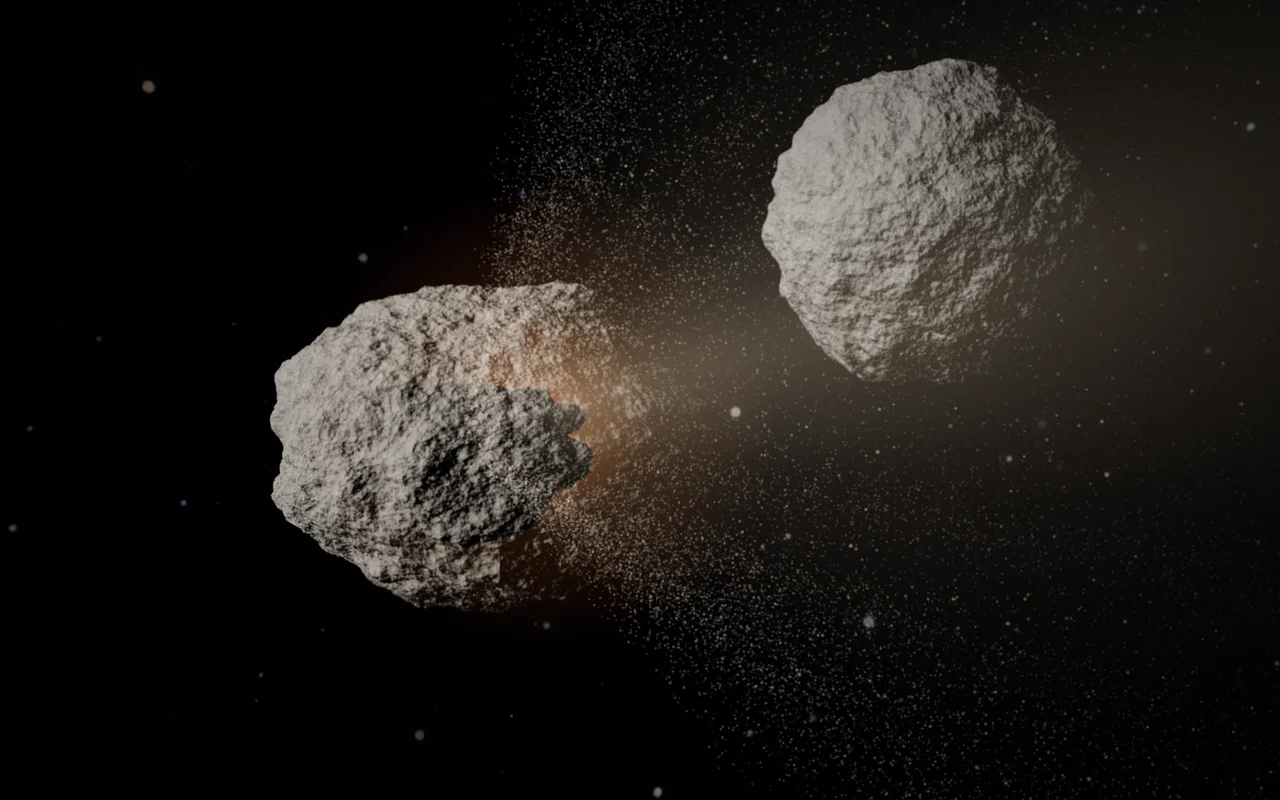
Image: Virtual Lab (3D illustration)
Dimorphos is a small moon of a larger asteroid called Didymos. The pair poses no threat to Earth, which is why it was chosen for the test. The question was simple: if a dangerous asteroid is ever found, can we knock it off course?
On 26 September 2022 the roughly 570-kilogram DART spacecraft hit Dimorphos head-on at more than 6 km/s. Before the impact, Dimorphos circled Didymos every 11 hours 55 minutes. Telescopes measured the new period by watching how the light changed as the two asteroids eclipsed each other.
The change was far larger than expected: the orbit shrank by 33.0 ± 1.0 minutes. Had the probe simply stuck to the asteroid, conservation of momentum predicts about 7 minutes. Most of the push therefore came not from the probe itself but from the material blasted out by the impact.
It is like throwing a rock backwards off a boat: the rock goes one way and the boat moves the other. Hubble and other telescopes watched a dust tail thousands of kilometres long stream from the asteroid — debris that acted like a rocket engine, adding an extra kick.
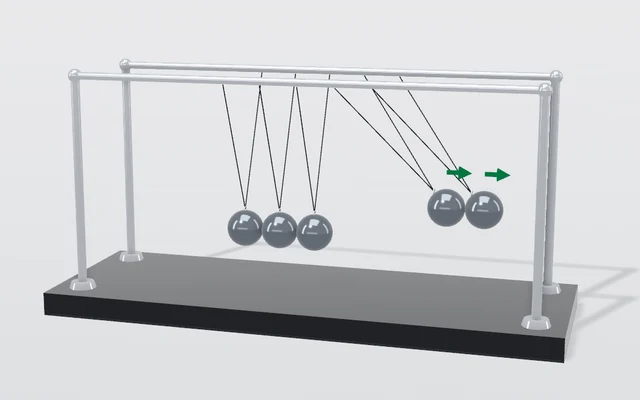 Try it in the labNewton's cradle3D lab on this site →Share on Telegram
Sources: Nature (DOI) · Physics World