Evidence that the Higgs boson also decays into muons
The results were announced on 3 August 2020 at the ICHEP international conference; CMS reached 3 sigma and ATLAS 2 sigma.
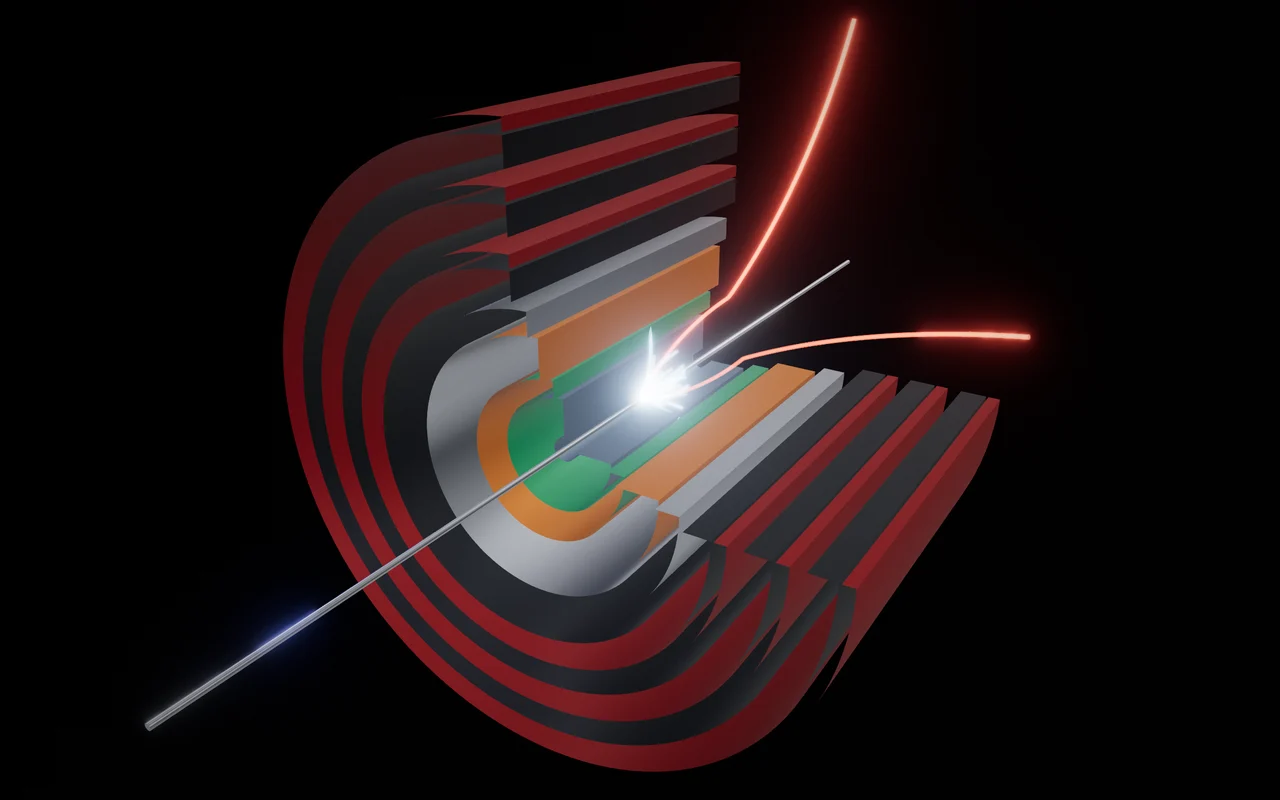
Image: Virtual Lab (3D illustration)
The Higgs field gives elementary particles their mass: the more strongly a particle interacts with it, the heavier it is. So the Higgs boson should often decay into heavy particles and only rarely into light ones.
Matter particles come in three 'generations'. The electron belongs to the first, the muon to the second — a heavy 'big brother' 207 times the electron's mass. Until then the Higgs had only been seen interacting with the heaviest, third-generation particles.
Proton collisions at the Large Hadron Collider make millions of muon pairs, almost none involving a Higgs. The detector measures how the muons bend in a strong magnetic field to find their energy; if two muons together carry 125 GeV, they may have come from a Higgs boson.
CMS saw a small but clear excess at that energy, with less than a 1-in-700 chance of being a fluke, and ATLAS pointed the same way. Together they showed the Higgs also couples to muons, with the predicted strength.
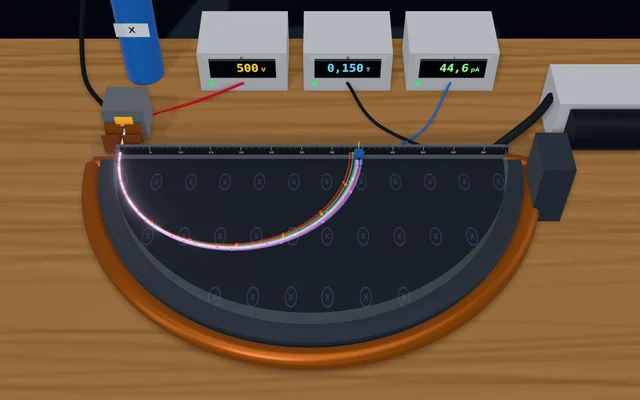 Try it in the labMass spectrometer3D lab on this site →Share on Telegram
Sources: CERN / ATLAS · CERN Courier