Home › Nobel Prize laureates › 2024
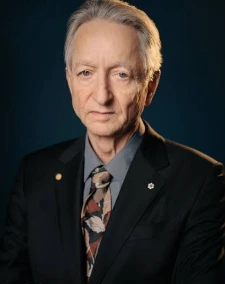
Geoffrey Hinton
born 1947 · UK / Canada
Prize motivation“for foundational discoveries and inventions that enable machine learning with artificial neural networks”
Shared the prize with: John J. Hopfield
The discovery
Modern artificial intelligence is built on artificial neural networks, inspired by the structure of the brain: each “node” is connected to others, and the strengths of the connections change as the network learns.
In 1982 John Hopfield created a network that stores images and later restores them. He used physical models describing how atoms acting as tiny magnets influence one another in magnetic materials. The network is given an “energy”, like a landscape: stored images sit at the bottoms of valleys. Given an incomplete picture, the network rolls like a ball downhill into the nearest valley — the correct image.
Geoffrey Hinton developed the idea using statistical physics and in 1985 created the “Boltzmann machine”, which learns from many examples, finds the characteristic features in data and can generate new examples. This work paved the way for today's deep learning.
Life
Born in 1947 in London, he studied experimental psychology at Cambridge and earned a doctorate in artificial intelligence at the University of Edinburgh in 1978. Since 1987 he has worked at the University of Toronto, Canada.
In 2012 a network he built with his students won an international image-recognition contest by a wide margin, sparking the rapid rise of deep learning. He also worked at Google from 2013 to 2023, leaving so he could speak freely about the risks of AI.
Where it is used today
Neural networks are now widely used for image recognition, translation, voice assistants and spotting disease in medical images.
In physics they help analyse huge data sets — in the search for the Higgs boson, detecting gravitational waves, and predicting new materials and protein structures.
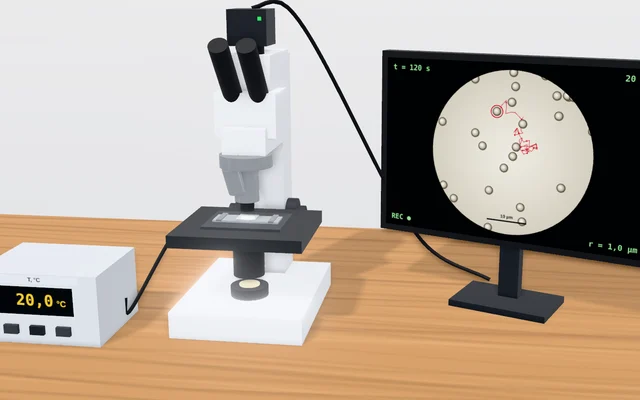 Try it in the labBrownian motion3D lab on this site →Share on Telegram
Sources: NobelPrize.org — 2024