Home › Nobel Prize laureates › 2018
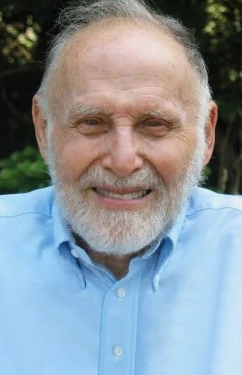
Arthur Ashkin
1922–2020 · USA
Prize motivation“for the optical tweezers and their application to biological systems”
Shared the prize with: Gérard Mourou, Donna Strickland
The discovery
Light exerts a very weak pressure on particles. A small transparent particle inside a laser beam bends the light, which pulls the particle towards the brightest part of the beam — its centre.
Arthur Ashkin learned to hold small particles with a laser beam, and in 1986–87 used a single beam to hold even living bacteria without harming them. This became known as “optical tweezers”.
It became possible to study processes inside living cells directly — for example, measuring the force with which molecular “motors” take steps inside a cell.
Life
Born in 1922 in New York, he studied at Columbia University and earned his doctorate at Cornell University in 1952.
He worked for many years at the famous Bell Labs, making many discoveries in laser physics. He died in 2020.
Where it is used today
Optical tweezers are widely used in biology and medicine to hold DNA, proteins and cells and measure their properties.
Similar methods can cool and trap atoms, paving the way for ultra-precise atomic clocks and quantum experiments.
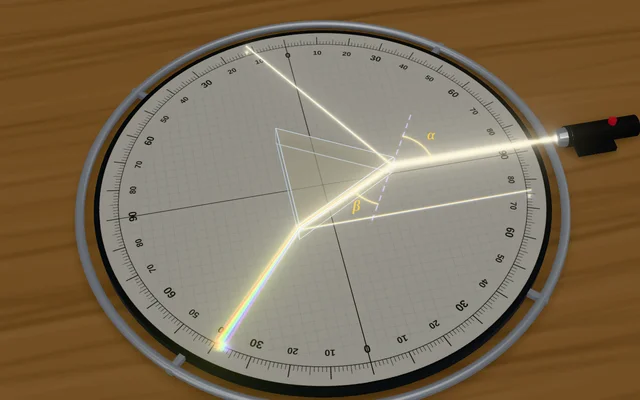 Try it in the labRefraction of light3D lab on this site →Share on Telegram
Sources: NobelPrize.org — 2018