Home › Nobel Prize laureates › 2017
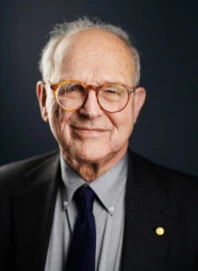
Rainer Weiss
1932–2025 · Germany / USA
Prize motivation“for decisive contributions to the LIGO detector and the observation of gravitational waves”
Shared the prize with: Barry C. Barish, Kip S. Thorne
The discovery
In 1916 Einstein predicted that massive objects moving with acceleration send out “waves” in space-time — but so weak that he himself thought they could never be measured.
In the 1970s Rainer Weiss worked out that a laser interferometer could detect such waves. The LIGO observatory was built on this idea: two detectors 3,000 km apart, each with 4-km arms.
On 14 September 2015 LIGO recorded, for the first time, a gravitational wave from two black holes that merged 1.3 billion years ago. As the wave passed, the detector's arm length changed by a thousandth of the width of a proton.
Life
Born in 1932 in Berlin, he fled the Nazis with his family to the USA in 1939. He studied at the Massachusetts Institute of Technology (MIT), earning his doctorate there in 1962.
He spent his whole career at MIT and was also a leader of the COBE satellite, which measured the universe's first light. He died in 2025.
Where it is used today
Gravitational waves have become an entirely new “eye” on the universe, with hundreds of black hole and neutron star collisions now recorded.
In 2017 a collision of two neutron stars was seen in both gravitational waves and light, showing that heavy elements such as gold are made in such collisions.
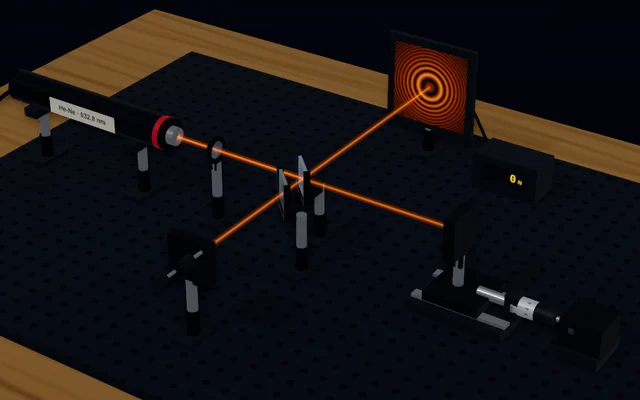 Try it in the labMichelson interferometer3D lab on this site →Share on Telegram
Sources: NobelPrize.org — 2017