Home › Nobel Prize laureates › 2015
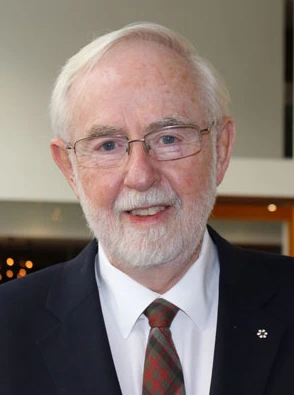
Arthur B. McDonald
born 1943 · Canada
Prize motivation“for the discovery of neutrino oscillations, which shows that neutrinos have mass”
Shared the prize with: Takaaki Kajita
The discovery
The neutrino is a very light particle with no charge that barely interacts with anything. It comes in three types, and the Standard Model of particle physics treated neutrinos as massless.
In 1998 Takaaki Kajita studied muon neutrinos made by cosmic rays in the atmosphere, using Japan's Super-Kamiokande detector. Fewer neutrinos arrived from below — through the whole Earth — than from above: on the longer journey they had time to change type.
In 2001 Arthur McDonald showed at Canada's SNO detector that electron neutrinos from the Sun change into other types on the way. A neutrino can change type only if it has mass, so the two experiments proved that neutrinos have mass.
Life
Born in 1943 in Sydney, Nova Scotia, Canada, he earned his doctorate at Caltech, USA, in 1969.
He worked at Princeton University, then returned to Canada as a professor at Queen's University and led the SNO detector, built 2 km down in a nickel mine near Sudbury.
Where it is used today
Neutrino mass had no place in the Standard Model, so the discovery opened a new chapter in particle physics and spurred the search for new theories.
Neutrinos may play a key role in the history of the universe, in exploding stars and in why there is more matter than antimatter — questions now studied by large new neutrino experiments around the world.
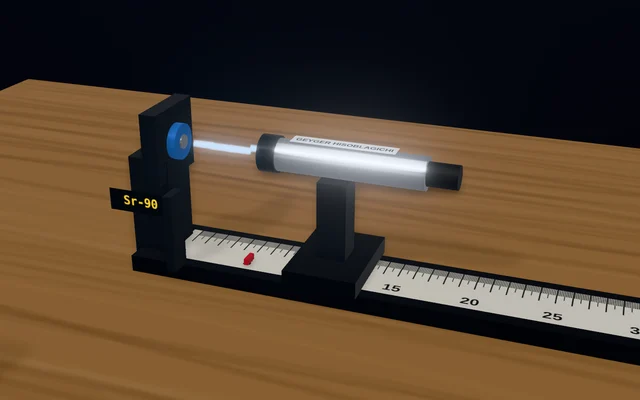 Try it in the labRadioactivity3D lab on this site →Share on Telegram
Sources: NobelPrize.org — 2015