Euclid telescope maps a billion objects in the sky
ESA has released 13 months of Euclid observations covering more than 900 million galaxies.
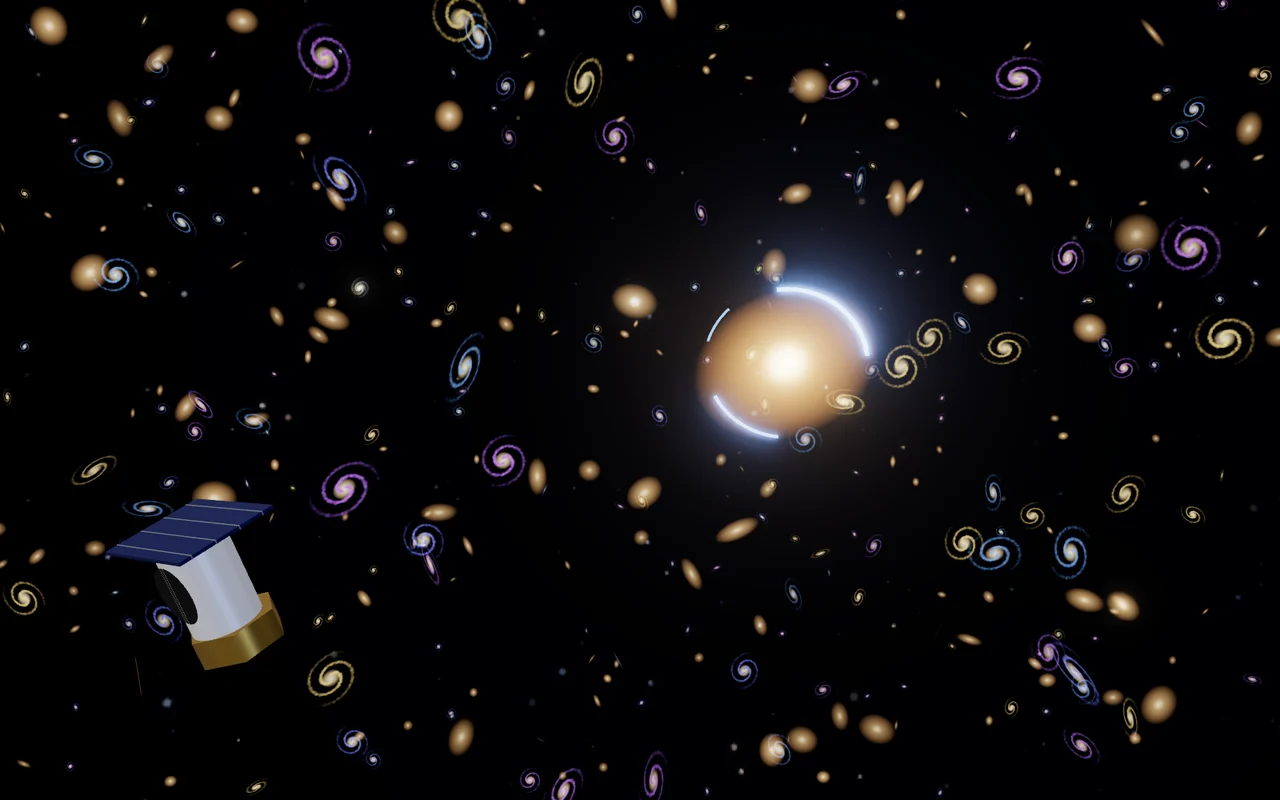
Image: Virtual Lab (3D illustration)
On 12 November the European Space Agency (ESA) opened the first major data set from its Euclid space telescope, called DR1-Foundation, to everyone. It holds about 13 months of observations covering more than 1,900 square degrees of sky, an area that would fit 9,500 full Moons.
The set contains more than a billion objects, over 900 million of them galaxies, in 1.7 petabytes (1.7 million gigabytes) of data. Scientists have already found around 15,000 gravitational lenses in it: the gravity of a nearby galaxy bends the light of a more distant one like a glass lens, stretching it into an arc.
Euclid was launched in July 2023 and sits at the L2 point, 1.5 million kilometres from Earth, where the pulls of the Sun and Earth balance. It has a 1.2-metre mirror and two instruments: one takes very sharp pictures in visible light, the other measures galaxy distances in infrared.
By knowing the shapes and distances of galaxies, scientists hope to rebuild 10 billion years of cosmic history layer by layer. Gravitational lenses show where invisible dark matter is and how much there is: the more the light is bent, the more mass lies there.
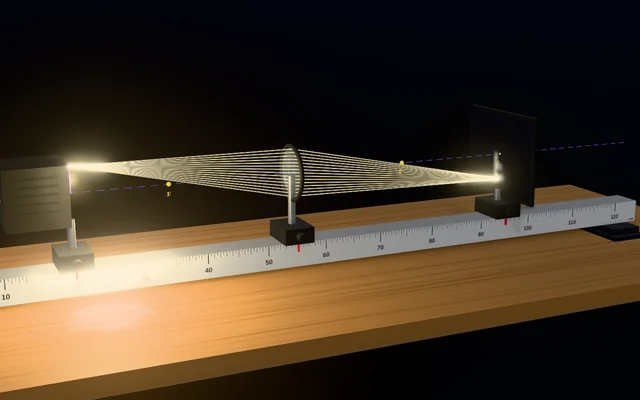 Try it in the labLenses and mirrors3D lab on this site →Share on Telegram
Sources: Physics World