2026 Nobel Prize goes to the scientist who hunts “ghost particles” in Antarctic ice
On 6 October the Royal Swedish Academy of Sciences announced the 2026 physics laureate.
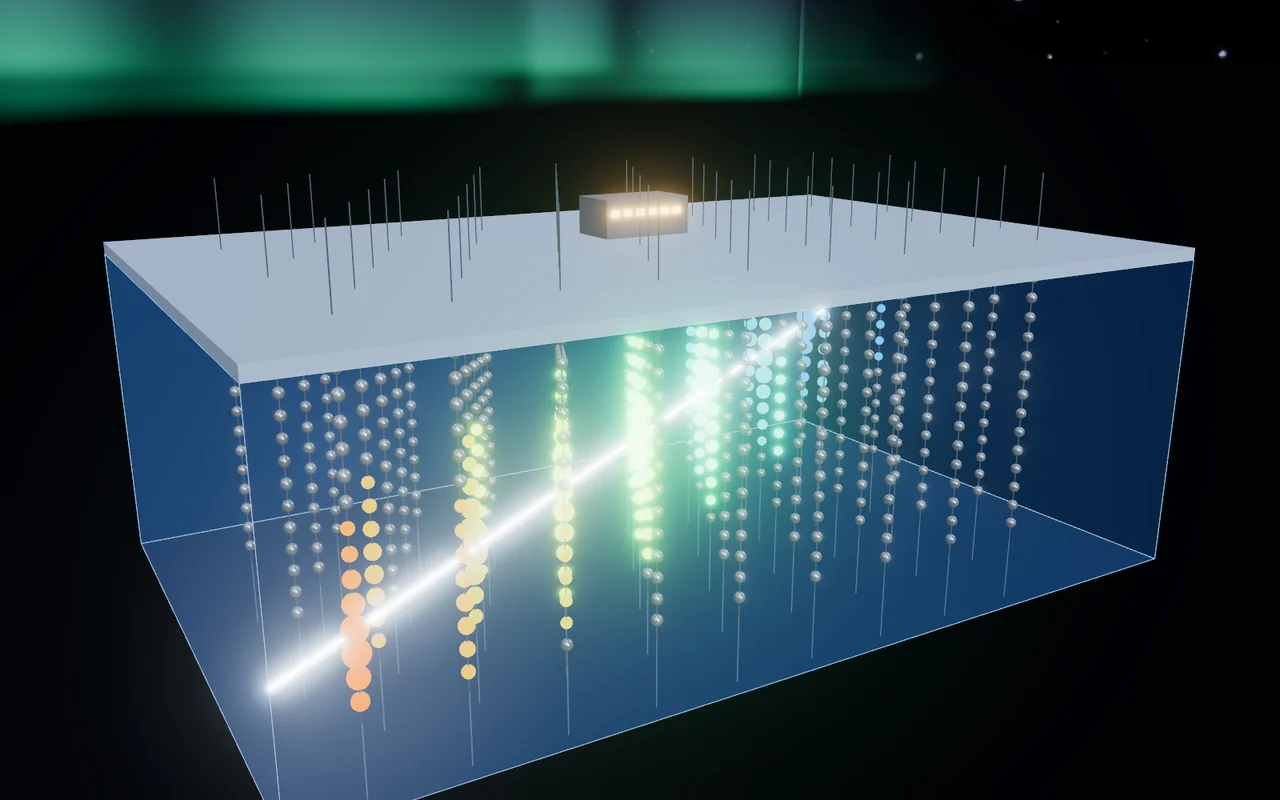
Image: Virtual Lab (3D illustration)
The prize went to Francis Halzen of the University of Wisconsin–Madison “for decisive contributions to the IceCube Neutrino Observatory and the discovery of high-energy neutrinos of astrophysical origin”. This year the prize was not shared, so the full 12 million Swedish kronor goes to one scientist. Belgium's prime minister congratulated him as the 11th Belgian Nobel laureate.
A neutrino is a neutral, extremely light particle that hardly interacts with anything; trillions pass unnoticed through our bodies every second. That is exactly why they can travel unhindered from distant corners of the Universe, bringing news of black holes and exploding stars.
To catch them, Halzen and colleagues turned a cubic kilometre of South Pole ice into a giant detector, lowering 5,160 light sensors into 86 deep holes. Very rarely a neutrino hits an atom in the ice and creates a charged particle, which gives off a faint bluish Cherenkov glow. From that light the sensors work out the particle's direction and energy.
In 2013 IceCube detected the first high-energy neutrinos from beyond our Galaxy, founding the new science of neutrino astronomy. When the call came, Halzen was at a science festival in Italy. “It was a great surprise,” he said.
 Try it in the labCloud chamber3D lab on this site →Share on Telegram
Sources: NobelPrize.org · AP / OPB