Parker Solar Probe flies closer to the Sun than anything before
The closest approach came on 24 December 2024; a signal confirming the probe was healthy arrived on 26 December.
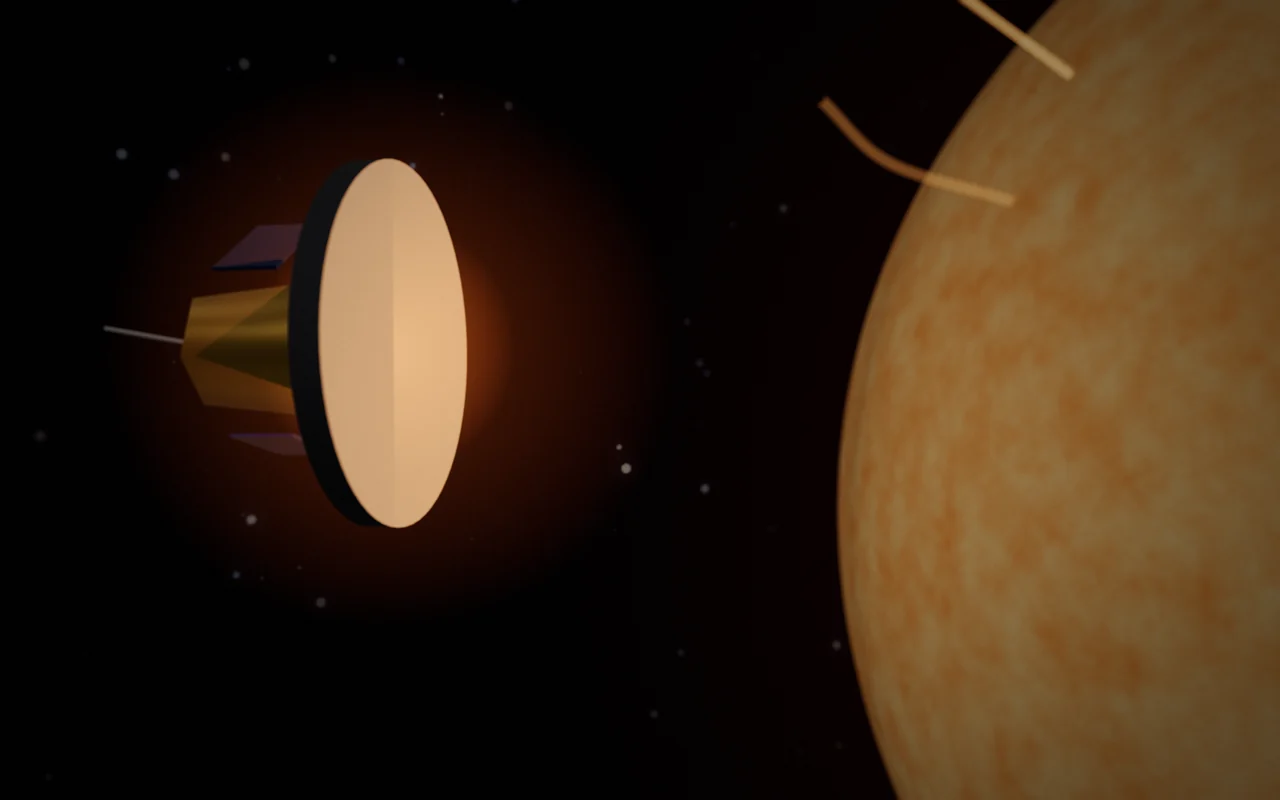
Image: Virtual Lab (3D illustration)
Parker Solar Probe launched in 2018 to study the corona, the Sun's outer atmosphere, up close. Each pass by Venus used its gravity to tighten the probe's orbit, bringing it ever closer to the Sun.
On 24 December the probe passed 6.1 million km from the solar surface. That may not sound close, but if the Earth–Sun distance were a football pitch, Parker would have been just 4 metres from the goal line.
The corona is hotter than a million degrees. The probe is protected by an 11.4-cm-thick carbon-foam heat shield, which reached about 980 °C at closest approach while the instruments behind it stayed near room temperature.
During the flyby the probe was out of contact, operating on its own. Engineers waited three days until, on 26 December, it sent back a signal that it was healthy. It is studying how the solar wind is accelerated and how particles reach enormous energies.
 Try it in the labThermal radiation3D lab on this site →Share on Telegram
Sources: NASA · Johns Hopkins University