The first Bose–Einstein condensate made of molecules
Sebastian Will's team published the result in Nature on 3 June 2024.
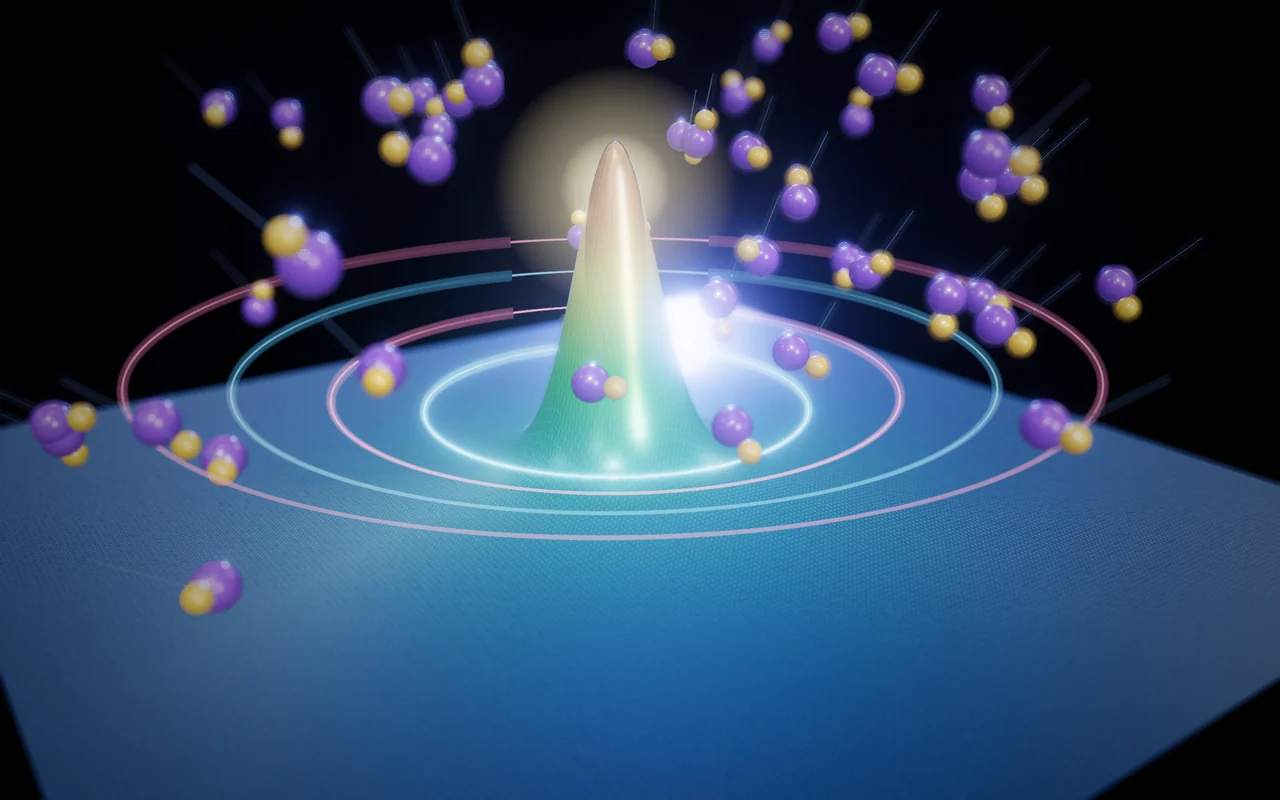
Image: Virtual Lab (3D illustration)
Cool particles far enough and they stop moving independently, 'merging' into one shared quantum state called a Bose–Einstein condensate. Satyendra Nath Bose and Albert Einstein predicted it a century ago; it was first made with atoms in 1995.
Molecules proved much harder. They are more complex than atoms — they rotate, vibrate and often react chemically when they collide, so they are 'lost' before they can be cooled enough.
The Columbia team 'shielded' sodium–caesium molecules with a microwave field that keeps them from getting too close and softens their collisions. Adding a second microwave field made cooling even more efficient, and the molecules crossed the condensation threshold.
The temperature dropped to 5 nanokelvin — just 0.000000005 degrees above absolute zero — and the condensate stayed stable for up to two seconds. Sodium–caesium molecules are polar, with one end positive and the other negative, so they interact even at a distance.
 Try it in the labGas laws3D lab on this site →Share on Telegram
Sources: Physics Today · ScienceDaily