Korea's 'artificial Sun': 100 million degrees for 48 seconds
The Korea Institute of Fusion Energy (KFE) announced the results on 20 March 2024.
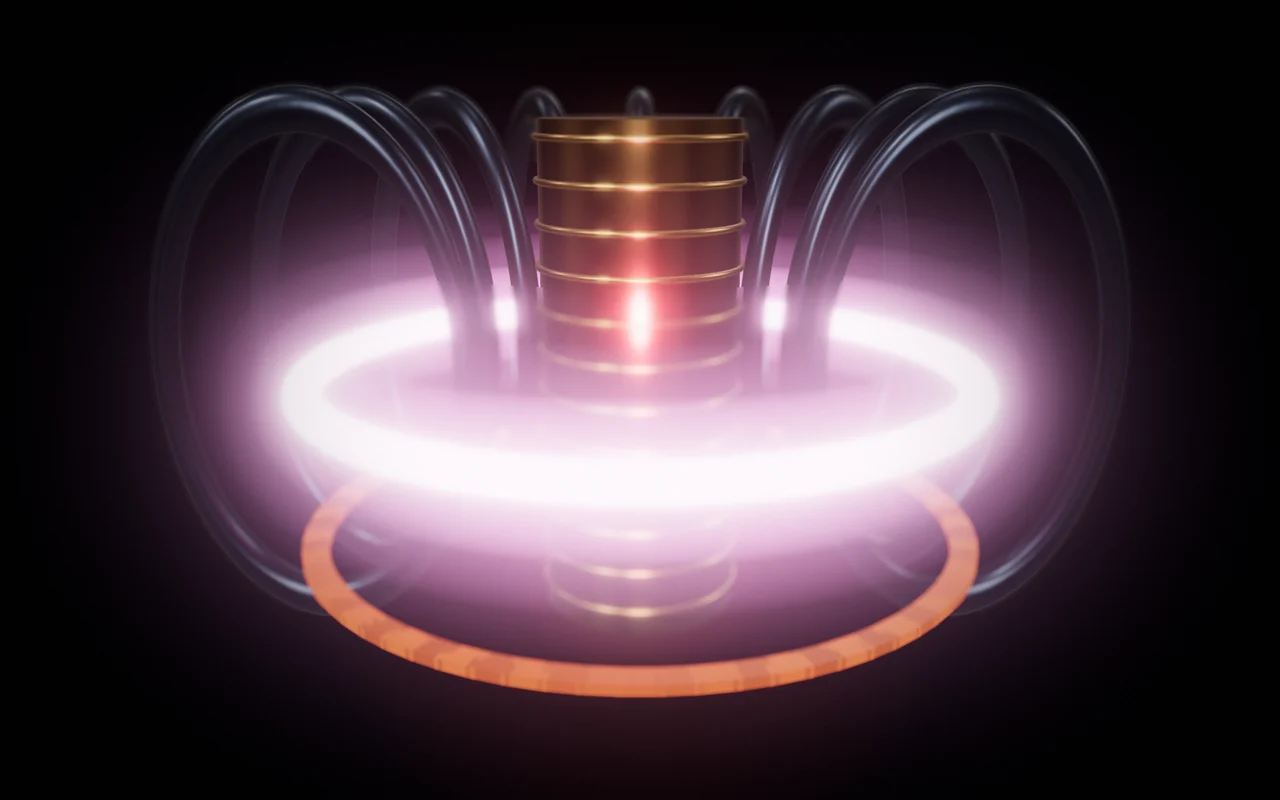
Image: Virtual Lab (3D illustration)
The Sun is powered by nuclear fusion: light nuclei merge into heavier ones, releasing enormous energy. To do this on Earth, a plasma of hydrogen isotopes must be heated above 100 million degrees and held by strong magnetic fields in a device called a tokamak.
KSTAR is a tokamak with superconducting magnets. It first reached 100 million degrees in 2018 and held that temperature for 30 seconds in 2021.
The main barrier to long pulses is overheating of the walls. The divertor — the part that takes the plasma's heat and 'ash' — used to be made of carbon. It was replaced with tungsten blocks, which have a very high melting point; under similar heat loads, the new divertor's surface heated up only 25% more.
In experiments from December 2023 to February 2024, KSTAR held 100-million-degree plasma for 48 seconds and sustained its high-performance 'H-mode' for 102 seconds. AI-based plasma control systems were also tested.
 Try it in the labPlasma ball3D lab on this site →Share on Telegram
Sources: EurekAlert! / KFE · Newswise