The most distant fast radio burst: an 8-billion-year-old signal helps weigh the universe
The result was published in Science on 19 October 2023, led by Stuart Ryder of Macquarie University and Ryan Shannon of Swinburne University of Technology.
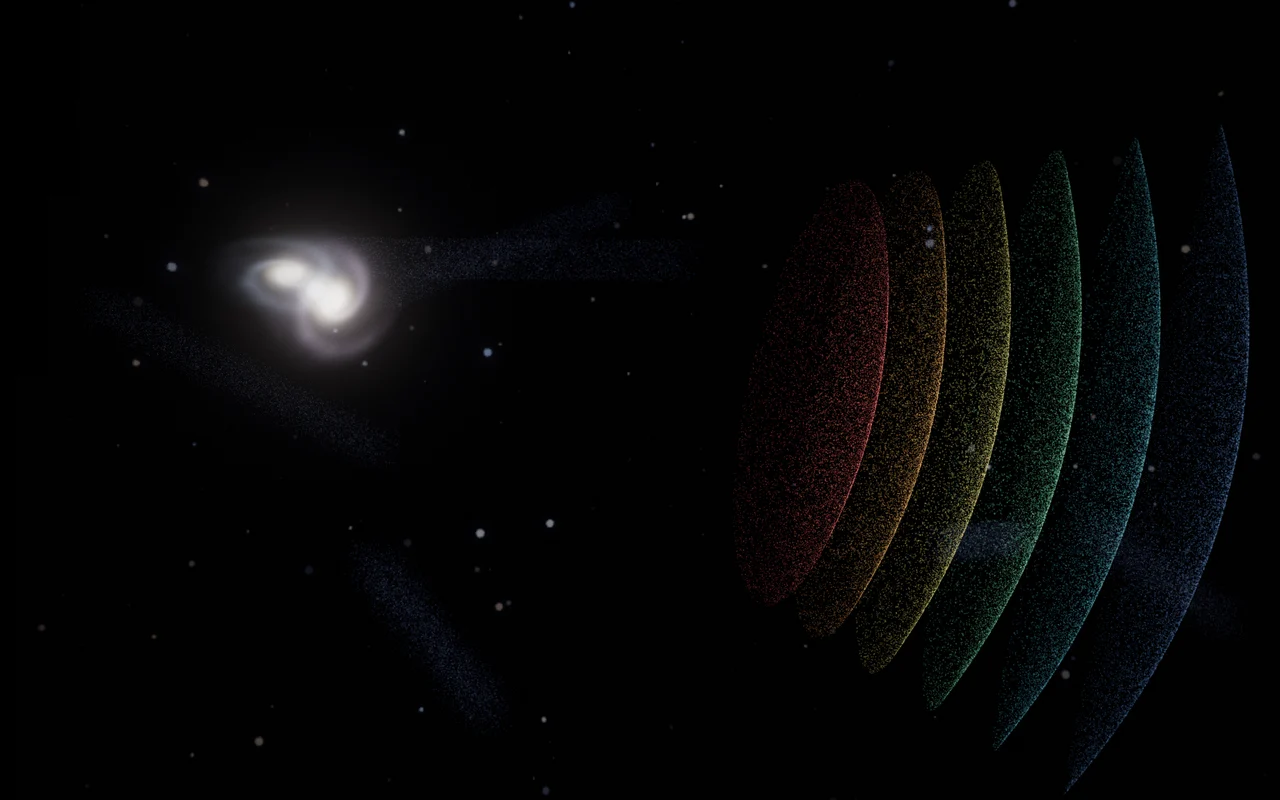
Image: Virtual Lab (3D illustration)
Fast radio bursts are powerful millisecond radio pulses from other galaxies. The first was found in 2007, and their nature is still not fully understood; many astronomers link them to magnetars, neutron stars with extremely strong magnetic fields.
ASKAP recorded FRB 20220610A on 10 June 2022, its many antennas pinpointing where on the sky it came from. ESO's Very Large Telescope in Chile then found a faint source at that spot: a small group of two or three merging galaxies.
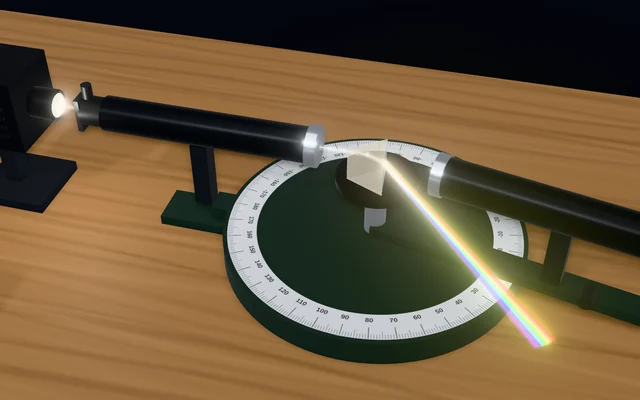
As a burst crosses intergalactic space, sparse electrons slow its waves, so lower frequencies arrive later than higher ones. This dispersion is like a prism splitting white light into colours, and the bigger the delay, the more matter lies along the path.
Cosmology suggests about half of the universe's ordinary matter is hidden in very thin gas between galaxies, hard to see any other way. Fast radio bursts let astronomers weigh this 'missing' matter, and the new record shows the method works over vast distances.
 Try it in the labPrism and dispersion3D lab on this site →Share on Telegram