Webb shows Neptune's rings clearly for the first time in over 30 years
The image was released on 21 September 2022, taken with Webb's NIRCam camera.
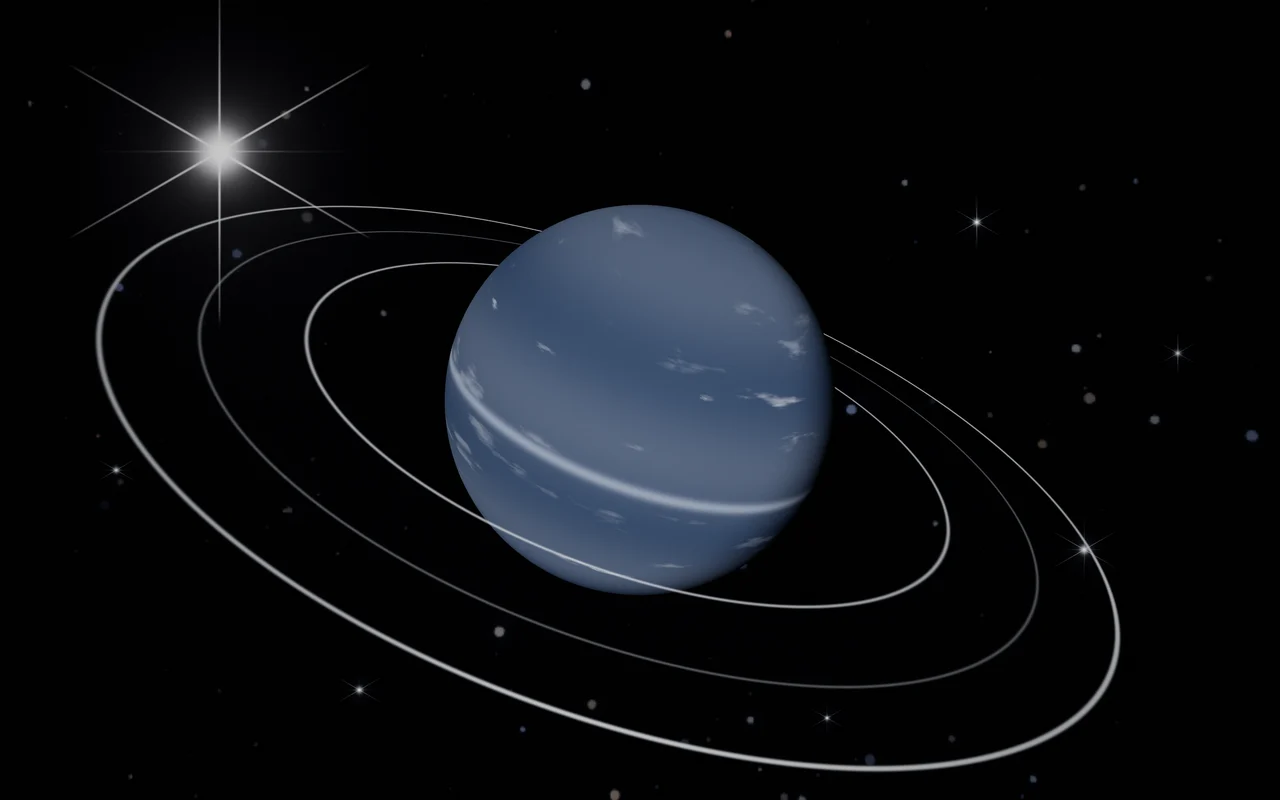
Image: Virtual Lab (3D illustration)
Neptune is the planet farthest from the Sun, 30 times farther than Earth. Its rings were first photographed clearly by Voyager 2 as it flew past in 1989, and no one had seen them so clearly since.
In ordinary images Neptune looks blue, but in Webb's it is almost dark grey: methane in its atmosphere strongly absorbs infrared light, so only high clouds above the methane layer show up as bright patches. A thin bright line circles the equator, linked to the atmosphere's circulation.
The rings are made of ice and dust and are very faint — nothing like Saturn's. That Webb could see them shows its extraordinary sensitivity. 'It has been three decades since we last saw those faint, dusty rings, and this is the first time we've seen them in the infrared,' said planetary scientist Heidi Hammel.
The brightest 'star' in the image is actually Neptune's largest moon, Triton. Covered in nitrogen ice, it reflects about 70% of the sunlight that hits it. Triton orbits backwards, so scientists think it is a Kuiper Belt object captured by Neptune's gravity.
 Try it in the labArtificial satellite3D lab on this site →Share on Telegram
Sources: NASA Webb