Webb takes its first direct image of a planet beyond the solar system
The images were released on 1 September 2022, in work led by Sasha Hinkley and Aarynn Carter.
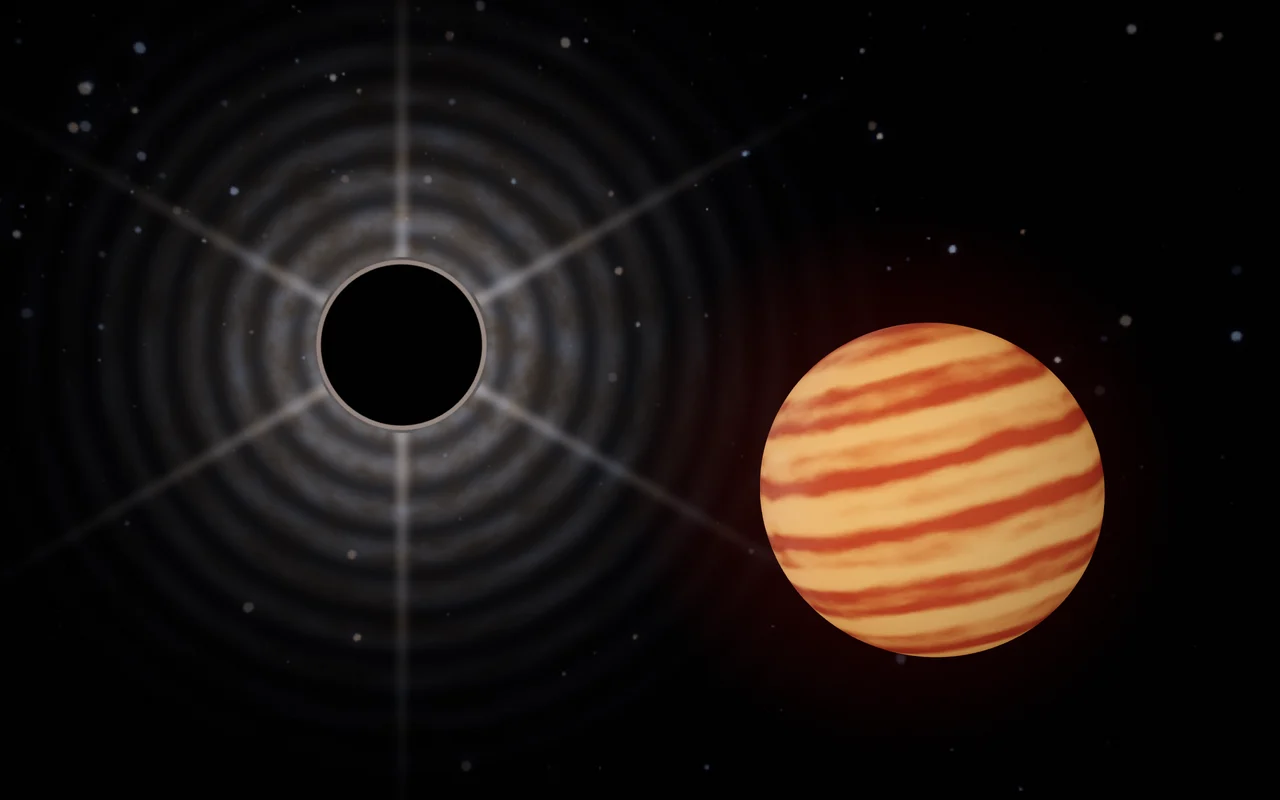
Image: Virtual Lab (3D illustration)
Most known exoplanets were found indirectly, through a star's wobble or dimming. Seeing a planet itself is very hard, because its star is thousands to billions of times brighter — like trying to spot a fly next to a distant lighthouse.
Webb carries coronagraphs: masks that block a star's light, much as the Moon blocks the Sun in an eclipse, revealing faint objects nearby. In infrared light HIP 65426 b is about 10,000 times fainter than its star; Webb's NIRCam and MIRI cameras imaged it at four wavelengths.
The planet lies 355 light years away in Centaurus. It was discovered in 2017 with the VLT in Chile, which, through Earth's atmosphere, could only see it at short infrared wavelengths. It is 6–12 times Jupiter's mass and just 15–20 million years old — 200 times younger than Earth — so it is still hot and glows in the infrared.
In the images the planet is a small bright dot with a star-like pattern — not its shape, but a signature of the telescope's optics. 'This is a transformative moment for astronomy,' said Hinkley. Webb proved able to image even smaller planets directly.
 Try it in the labThe eye and optical instruments3D lab on this site →Share on Telegram
Sources: NASA Webb blog · ESA/Webb